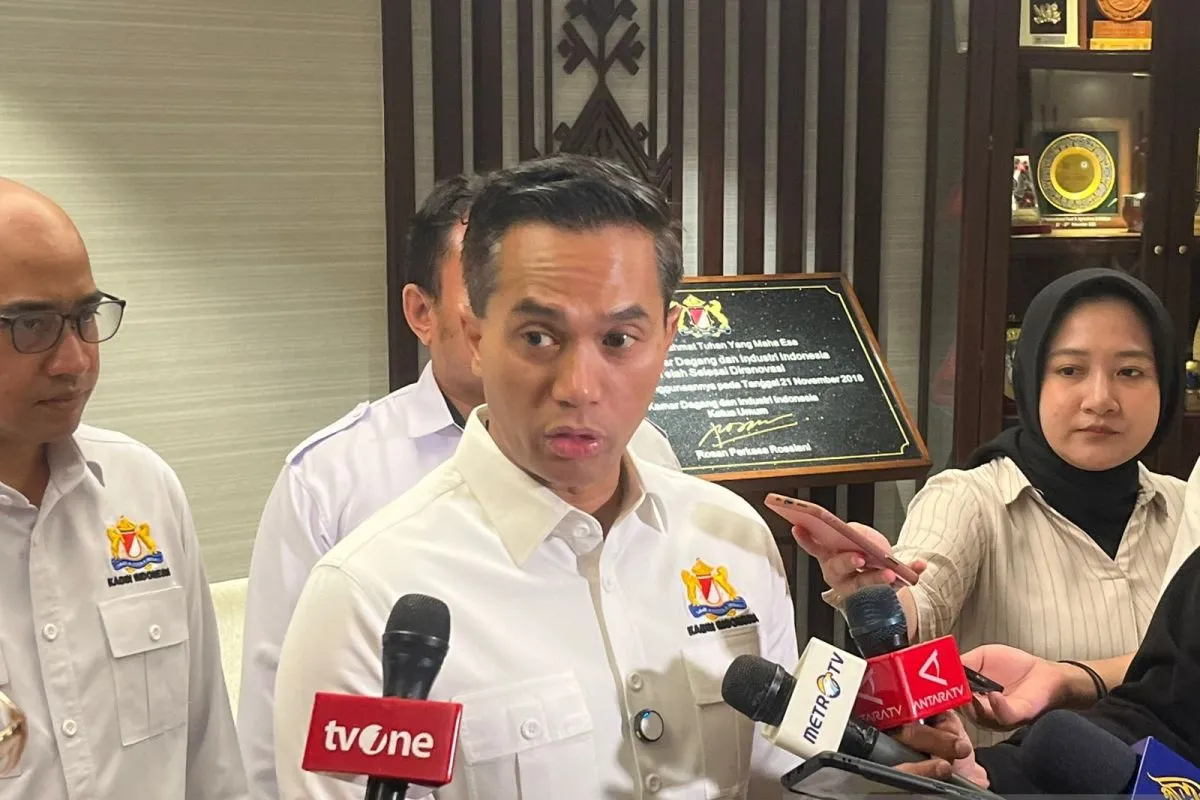
"We appreciate the government's performance. The government programs implemented since early 2025 are starting to show results this year," said Anindya Bakrie, Chairman of the Kadin, in an official statement here on Wednesday.
The Chamber assessed this achievement was due to the acceleration of government spending since the beginning of the year, the implementation of massive free nutritious meal program (MBG), construction of 3 million houses, and implementation of other priority programs that have contributed to driving growth.
In addition, investment activity that has been moving since the beginning of the year is also a major supporting factor, he said. Amidst the still challenging global conditions, the chairman of Kadin stated that Indonesia's economic growth of 5.61 percent is an achievement that deserves appreciation.
This figure was even recorded as the highest among G20 member countries in the same period. "This is a proud achievement," he said.
The Chamber also sees the improvement in the national economy starting to be supported by a more balanced combination of domestic consumption, increasingly open exports, and expanding investment flows to the regions.
"Recently, we've succeeded in opening new export markets. Although we're just starting out, the impact is already visible, including on incoming investment," he said.
Investment trends, he said, also show positive developments, not only dominated by large projects, but also starting to include medium-scale investments that have the potential to become drivers of the regional economy.
"In the future, it's up to us to hold discussions with local governments to increase investment and contribute to regional progress. Economic growth must also occur locally," he added.
He also stated that the trade balance performance also strengthened national economic optimism, given that Indonesia recorded a surplus of US$3.32 billion in March 2026, continuing a trend of surpluses for 71 consecutive months since May 2020.
Meanwhile, investment realization in the first quarter of 2026 reached IDR498.8 trillion (about US$28.7 billion), representing 7.2 percent annual growth, with the downstream sector remaining the primary contributor.
The Chamber emphasized the importance of maintaining this momentum by strengthening coordination between the central and regional governments, so that economic growth is not only concentrated in certain regions but is also evenly distributed.
"Growth cannot only occur in the center. The regions must become sources of new growth," he said.
The Chamber is also encouraging an increase in regional transfer funds to strengthen local economic activity, particularly for micro, small, and medium enterprises (MSMEs).
Data from the Statistics Indonesia (BPS) shows that economic growth in the first quarter of 2026 was driven by a 21.81 percent increase in government spending and a 5.96 percent increase in investment, while household consumption remained stable at 5.52 percent.
Kadin believes that the combination of targeted government spending, strengthening investment, and strategic programs such as the MBG has created a significant positive effect on the economy.
"This reflects a very strong multiplier effect on the domestic economy," said the Chairman of the Chamber.
Related news: Indonesia records 5.61 percent economic growth in Q1 2026
Related news: Indonesia able to escape 5 percent growth trap: Purbaya
Translator: Ahmad Muzdaffar Fauzan, Katriana
Editor: M Razi Rahman
Copyright © ANTARA 2026


