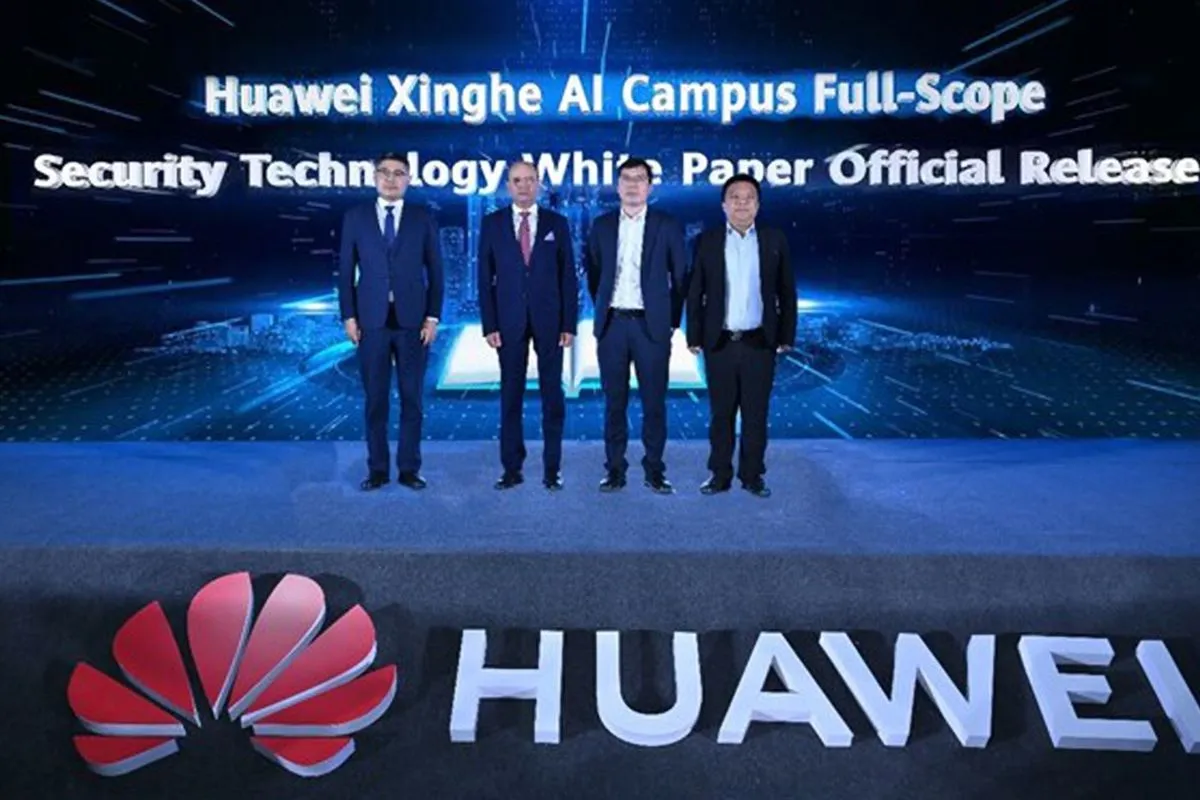
The white paper introduces for the first time four key pillars of campus security—connectivity, asset, spatial, and privacy security—to build a full-domain security architecture with multi-layered protection. This marks a new stage in AI campus security, evolving from single-point defense to all-domain awareness and proactive intelligent defense.
The white paper provides a systematic approach to building a full-scope security technology architecture and elaborates on the world's first complete framework for campus network security.
"Security is the cornerstone of AI campuses," said Ricky Zhu, Vice President of the Campus Network Domain, Huawei's Data Communication Product Line. "By integrating digital and physical domains, Huawei pioneers multi-layered protection across connectivity, asset, spatial, and privacy security. This development shifts campuses from reactive defense to proactive awareness and intelligent safeguarding."
Key highlights of the four major campus security dimensions include:
- Connectivity security: On the wireless side, Huawei's exclusive Wi-Fi Shield technology eliminates the risk of packet eavesdropping at the physical layer. On the wired side, end-to-end MACsec combined with Post-Quantum Cryptography (PQC) provides long-term security for data transmission even as quantum computing matures, protecting against data leakage.
- Asset security: The surging number of dumb terminals in governments, finance, and other sectors has heightened the risk of network attacks. To address this, Huawei's solution leverages clustering identification to automatically recognize dumb terminals with 95% accuracy. By combining terminal behavior anomaly detection with local inference on switches, the solution can detect traffic anomalies in seconds and proactively block them, effectively preventing network intrusions and lateral movement. The resulting benefits include terminal visibility and controllability without unauthorized access and spoofing.
- Spatial security: Huawei's Wi-Fi channel state information (CSI) sensing technology detects spatial security conditions through a single wireless access point (AP), preventing intrusions into sensitive areas. The technology analyzes only wireless signal disturbance patterns to safeguard spatial security while protecting personal privacy to the maximum extent.
- Privacy security: In executive rooms, meeting rooms, hotel guest rooms, and other sensitive environments, traditional methods for detecting hidden imaging devices are often inefficient and prone to high miss rates. Huawei tackles this by launching the iGuard spycam-detecting AP, which offers three key advantages—comprehensive detection, precise detection, and 24/7 operation—to safeguard trade secrets and personal privacy in such private places.
For details of the white paper, visit https://e.huawei.com/en/documents/products/enterprise-network/c1d4f9aa8b514ac188db924a0cb237dd.
Source: Huawei
Reporter: PR Wire
Editor: PR Wire
Copyright © ANTARA 2026


