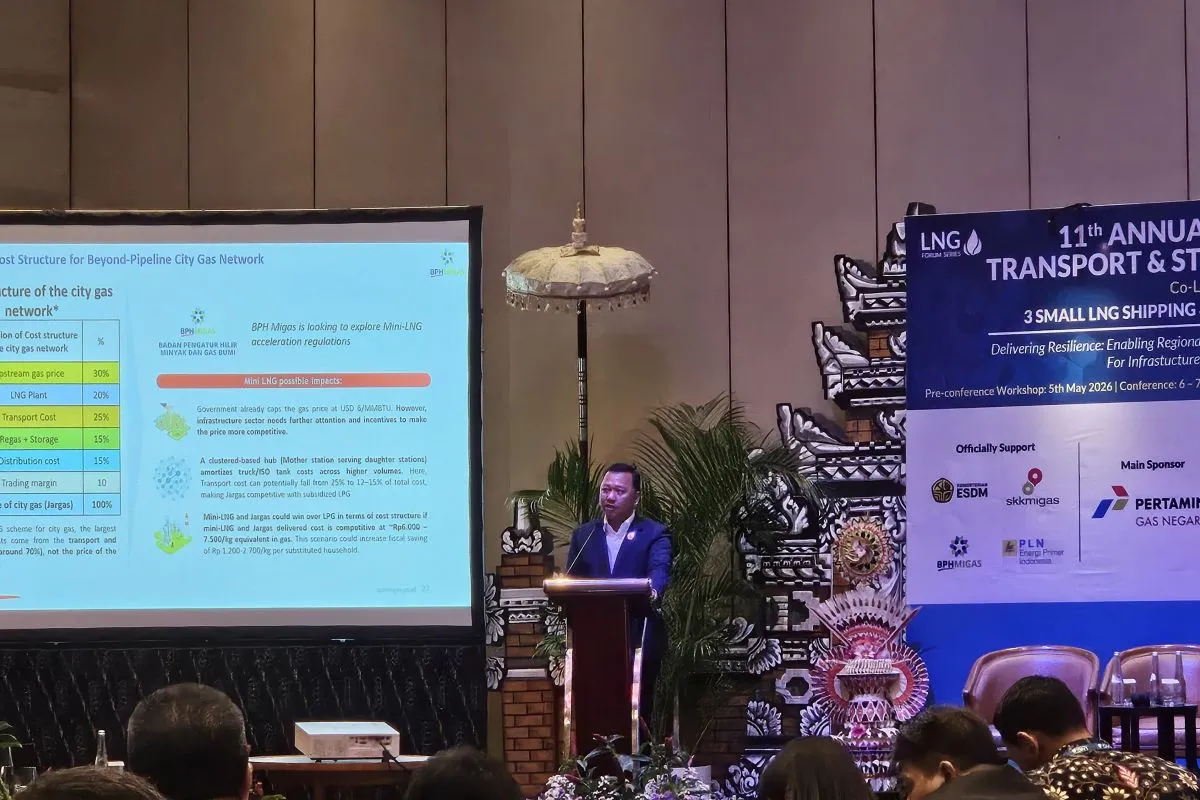
BPH Migas committee member Fathul Nugroho stated in a statement on Saturday that this step will strengthen national energy security and reduce dependence on imported LPG.
He stated that optimizing CNG main stations and developing mini-LNG infrastructure will open up more energy options for the public, beyond LPG.
"These options can also increase the effectiveness of gas distribution and support the government's target of converting to safer, cleaner, and more efficient energy sources," Fathul said.
He explained that household energy needs are currently dominated by subsidized LPG, which burdens the state's fiscal position and triggers high dependence on imports.
Currently, Indonesia is importing 81 percent of LPG to meet national demand.
The development of CNG and LNG for households is also in line with President Prabowo Subianto's vision of promoting national energy self-sufficiency.
CNG is already being used in several hotels, restaurants, and kitchens supporting the government’s free meals program, with raw materials sourced domestically.
The government is now preparing to expand its use to households by developing CNG in 3-kilogram cylinders.
In the 2025-2029 National Medium-Term Development Plan (RPJMN), the government targets the development of a natural gas network for households to reach 350,000 house connections by 2029.
To achieve this target, BPH Migas assesses the need to accelerate regulations related to CNG main stations and mini-LNG terminals to facilitate faster investment.
Furthermore, the government-to-business partnership financing model is also considered crucial to support infrastructure development, particularly in eastern Indonesia, which faces geographical challenges.
"To expand the reach of the natural gas network using CNG, this can be carried out by converting gas filling stations into mother stations. Meanwhile, for non-pipeline gas distribution, mini-LNG can be used," Fathul said.
"This way, the abundant natural gas potential can be immediately utilized to achieve national energy independence," he added.
CNG is derived from natural gas—primarily methane (C1) and ethane (C2)—which are abundant domestically.
CNG has a pressure of around 250 bar, stronger than LPG, which has a pressure of around 5-10 bar. This difference in gas pressure is the main cause for adjusting the CNG in smaller cylinders, particularly for safety purposes.
Related news: Indonesia to keep subsidies in LPG-to-CNG transition
Related news: Govt targets 3-kilogram CNG for household use starting this year
Related news: Indonesia pushes CNG as cheaper LPG alternative
Translator: Kelik Dewanto, Yashinta Difa
Editor: Azis Kurmala
Copyright © ANTARA 2026


