China’s WtE technology development is comparable with that of other countries in terms of quality and cost,Jakarta (ANTARA) - Indonesia is drawing on expertise from international partners, including companies from China, to develop its national waste-to-energy (WtE) ecosystem, according to PT Daya Energi Bersih Nusantara (Denera), Danantara Indonesia’s clean energy subsidiary.
“Over the past 20 years, they have been very active not only in building but also in developing the latest waste-to-energy technology at the highest standard,” Denera CEO Fadli Rahman said at a press conference hosted by the Government Communication Agency here on Monday.
China’s WtE technology development is comparable with that of other countries in terms of quality and cost, he noted.
However, Rahman highlighted that Chinese partners stood out from companies from other countries in terms of their ability to deliver projects quickly, as they are committed “to build as soon as possible and stay as long as possible.”
“We need that because we need an acceleration as we are facing a waste crisis,” the Denera CEO said.
He also said these factors explain the dominance of Chinese companies among the winners of the first phase of the WtE tender earlier this year.
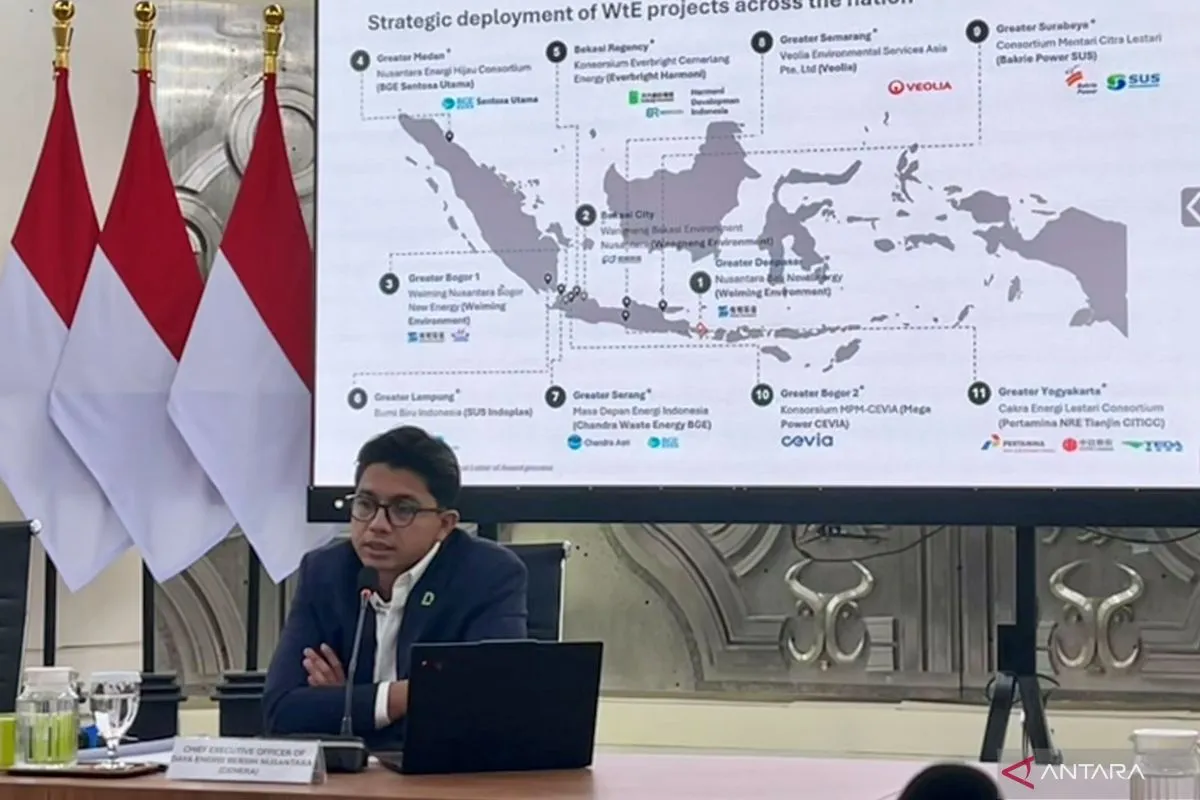
The first bidding phase for three WtE installation projects was won by two Chinese partner companies: Zhejiang Weiming for sites in Bogor and Denpasar, and Wangneng Environment for the site in Bekasi.
As the first three sites enter the development stage, Rahman said cooperation between the Chinese companies and their local partners has been strong, ensuring a smooth process through to completion and eventual operation. Despite all foreign companies winning the first tender phase being Chinese, the Denera CEO stressed that WtE investment opportunities in Indonesia are open to all.
He said that in the second phase of the bidding process for eight WtE sites, Indonesia also welcomed bidders from South Korea, Japan, India, and Singapore, in addition to China. Ultimately, the eight selected partners comprised four domestic consortia and four international consortia, led by two French and two Chinese companies.
Moreover, Denera is striving to ensure that all WtE facilities in Indonesia are developed in accordance with European Union standards, which requires inputs and resources from more partners, Rahman said.
Indonesia aims to manage 100 percent of its waste by the end of 2029, with the proportion of waste managed in 2026 targeted at 63.41 percent, according to the National Medium-Term Development Plan for the 2025-2029 period.
Related news: Indonesia eases WtE investment with land, permits, power support
Related news: Indonesia prepares for EV battery waste peak expected in 2040
Translator: Nabil Ihsan
Editor: M Razi Rahman
Copyright © ANTARA 2026


