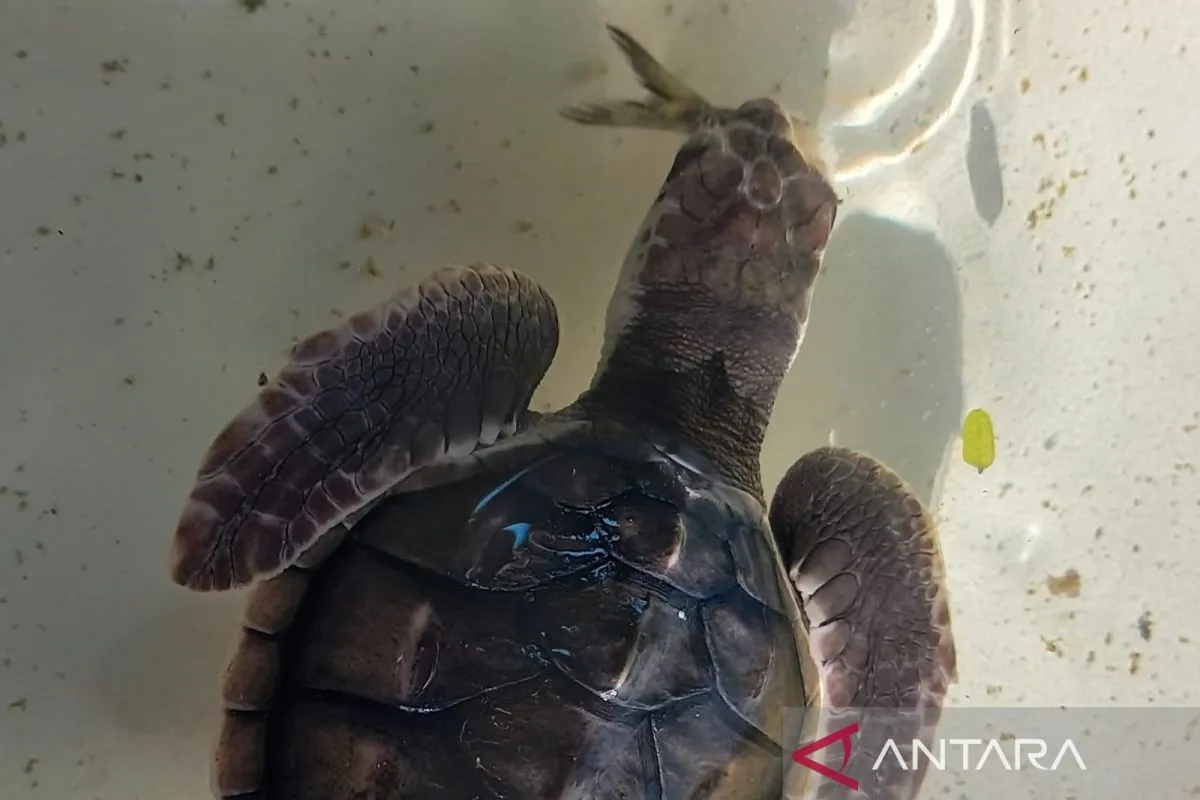
Conservation cannot run well if community needs are not yet fulfilled. Turtle hunting occurs because people’s basic needs have not been met,West Lombok (ANTARA) - On Indonesia's Lombok Island in West Nusa Tenggara, Masnun (47) has devoted his life to protecting sea turtles through the conservation group Kerabat Penyu Lombok, leading efforts to safeguard the species and their nesting beaches.
One day, he was roaming Kuranji Dalang Beach in West Lombok District and paused beneath the shade of a 10-meter Australian pine. The beach is among the favorite nesting spots for turtles.
Lombok Island is a natural habitat for three species of sea turtles: the olive ridley (Lepidochelys olivacea), the green (Chelonia mydas), and the hawksbill (Eretmochelys imbricata). They are often found along the island’s northern coast, including West Lombok.
Before the group’s conservation efforts, many locals hunted turtle eggs there for personal consumption or sale in traditional markets. As a result, the sea turtle population steadily declined, raising concerns within the community and prompting action to reverse the trend.
Recognizing the looming crisis, more and more residents began to understand the ecological value of sea turtles.
This growing awareness has convinced them to refrain from disturbing the reptiles, allowing the turtles to lay their eggs in semi-natural nests within the conservation zone.
Challenges
Wearing only a polo shirt and a sarong, Masnun walked through Kuranji Dalang Village toward a turtle hatchery, carrying a used mineral water cup in his hand.
The cup served as a makeshift container for the small frozen fish he had brought as feed. At the hatchery, he immediately placed the fish into a bowl of water, hoping to thaw them quickly.
Noticing his presence, four sea turtles slowly swam to the edge of the pond, anticipating their favorite meal. To make feeding easier, Masnun cut the fish into smaller pieces before scattering them into the pond. He then watched the turtles one by one, his expression softening as they fed.
The Kerabat Penyu Lombok group reported that around one thousand sea turtle eggs hatched over the past year, with the vast expanse of the sea welcoming the newborns as they made their way into the wild at Kuranji Dalang Beach.
“There are still some people who hunt turtle eggs for sale. In response, we often buy the eggs ourselves because these people would face legal consequences if they sold them in markets,” Masnun said in mid-November 2025.
Established in 2015, Masnun’s turtle conservation group has only three active members. A decade on, the group continues to face challenges, most notably locals’ habits of littering and hunting turtle eggs along the beach.
Those who consume such eggs often remain unaware that sea turtles are legally protected marine species in Indonesia.
Sea turtles have been classified as endangered both internationally and nationally.
Indonesia has ratified several global agreements, including the Convention on International Trade in Endangered Species of Wild Fauna and Flora (CITES), which prohibits the commercial trade of all sea turtle species.
Indonesia has incorporated CITES into domestic laws and policies, thereby outlawing any activities that threaten the survival of sea turtles and their habitats.
Muhammad Barmawi, head of a local Coastal and Marine Resources Monitoring Center under the Ministry of Marine Affairs and Fisheries (KKP), stated that the government remains committed to effective surveillance and public education on the endangered status of sea turtles.
He emphasized that the monitoring center has been working closely with the ministry’s Special Police for Coastal Area and Small Island Management in patrols aimed at preventing citizens from hunting turtle eggs.
Moreover, the KKP has been working to formulate the 2025–2029 National Action Plan for the Conservation of Sea Turtles and Cetaceans, with a public consultation involving a range of relevant stakeholders already completed.
The consultation, which involved representatives from central and local governments, WWF Indonesia, and civil society organizations, produced key recommendations, including establishing centers of excellence for sea turtle conservation in three regions.
KKP Director of Species and Genetic Conservation, Sarmintohadi, described the national action plan as a key reference for implementing an integrated and sustainable approach to protecting endangered marine species.
Related news: Action plan on sea turtles involves multi-stakeholder engagement: govt
Ecotourism opportunities
In an effort to balance conservation with community welfare, the government has begun promoting the concept of ecotourism—which highlights the importance of environmental sustainability—on Lombok, including at Kuranji Beach.
By integrating cultural appreciation, environmental awareness, and economic opportunity, the initiative aims to ensure that nature-based tourism not only attracts visitors but also sustains the environment.
Through ecotourism, the government hopes to raise public awareness that tourism can support conservation by helping preserve turtle habitats and protect the marine ecosystem.
This approach is expected to provide economic benefits for local communities and regional governments.
Ecotourism is not merely about traveling in natural surroundings. It emphasizes observing and understanding nature and culture, supporting conservation, and prioritizing services provided by local communities to increase their income.
Ultimately, ecotourism can be described as a form of tourism closely tied to green, ecofriendly principles. Its development strategies are firmly rooted in conservation.
Saptono Waspodo, a marine science expert at Mataram University, argued that it is vital for the government to guide coastal communities toward alternative, environmentally friendly source of income so they no longer depend on selling turtle eggs.
“Conservation cannot run well if community needs are not yet fulfilled. Turtle hunting occurs because people’s basic needs have not been met,” he said.
As a great nation with a vast maritime territory and rich marine biodiversity, it is only natural for Indonesia to share in the global responsibility to ensure the survival of endangered marine species.
Through established laws and regulations, as well as the ongoing formulation of a national action plan, the Indonesian government has expressed its determination to keep the country a safe and thriving habitat for sea turtles.
Still, active participation from the wider public remains essential to pave the way for effective conservation measures. In other words, both government policies and public environmental awareness are vital to this cause.
Related news: Natural factors, humans threaten sea turtle ecosystem: Ministry
Related news: Sea turtle conservation action plan needs scientific data support: KKP
Related news: Saving sea turtles paramount to maintaining healthy marine ecosystem
Editor: M Razi Rahman
Copyright © ANTARA 2025


