The ministry's Director General of Digital Ecosystems, Edwin Hidayat Abdullah, noted that almost all cybercrime methods, such as scam calls, spoofing, smishing, and social engineering fraud, use mobile phone numbers as their primary tool.
"The losses from this digital fraud have reached more than Rp7 trillion (US$407 million). In fact, there are more than 30 million scam calls every month, and each person receives at least one spam call once a week. Therefore, we implemented a policy requiring SIM card registration using facial recognition," he said on Wednesday.
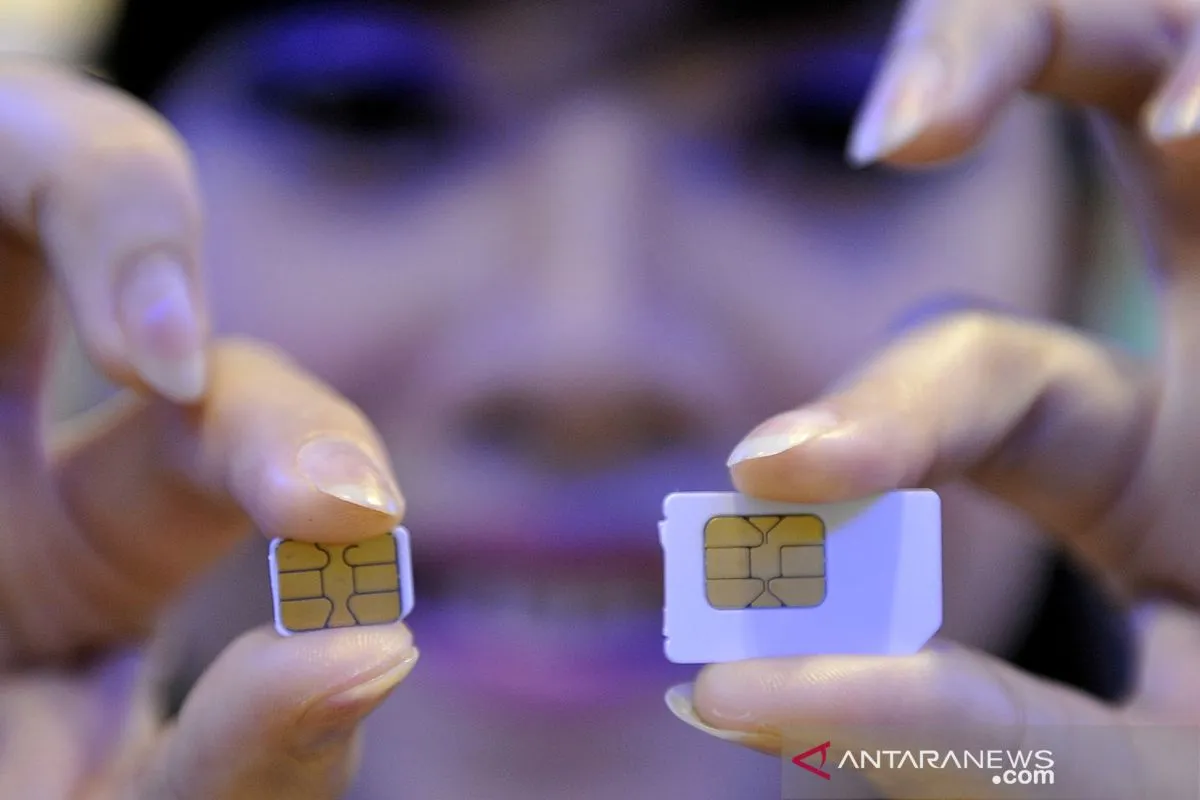
His office and the Indonesian Telecommunications Providers Association (ATSI) announced the implementation of biometric facial recognition-based SIM card registration for new customers, which will begin on January 1, 2026.
This registration is still voluntary and is still in the trial phase before the policy is fully implemented on July 1, 2026.
Abdullah explained that the initial phase on January 1 will use a hybrid system where prospective new customers can choose between two methods: using their National Identification Number (NIK) as before, or directly using facial biometric verification.
Then, starting July 1, 2026, registration for new customers will be entirely biometric.
According to him, the regulation also aims to help operators clean up their databases of inactive numbers since more than 310 million mobile phone numbers are in circulation, despite Indonesia's adult population being around 220 million.
"This would ensure cellular frequency signals are used by legitimate, loyal customers rather than by digital crime perpetrators," he pointed out.
As of September 2025, the number of validated mobile phone subscribers reached over 332 million. However, a report from the Indonesia Anti-Scam Center (IASC) recorded 383,626 accounts reported as fraudulent, with total public losses reaching Rp4.8 trillion (US$279 million).
This new policy is an update to the Minister of Communication and Informatics Regulation (Permenkominfo) Number 5 of 2021 concerning Telecommunications Provisions.
Under the previous regulation, new mobile phone number users were required to register their SIM cards using their NIK and Family Card (KK) numbers.
However, in practice, NIK and Family Card data were often borrowed or used without consent to commit digital crimes, such as spreading hoaxes, online gambling, spam, and various fraudulent schemes.
Facial recognition–based SIM registration will ensure mobile phone numbers are activated solely for verified owners, addressing the gap through the use of unique and hard-to-forge biometric data.
Related news: Ministry conducts public test to review e-SIM implementation
Related news: Ministry seeks probe into alleged SIM card data leak
Translator: Pamela Sakina, Resinta Sulistiyandari
Editor: Azis Kurmala
Copyright © ANTARA 2025


