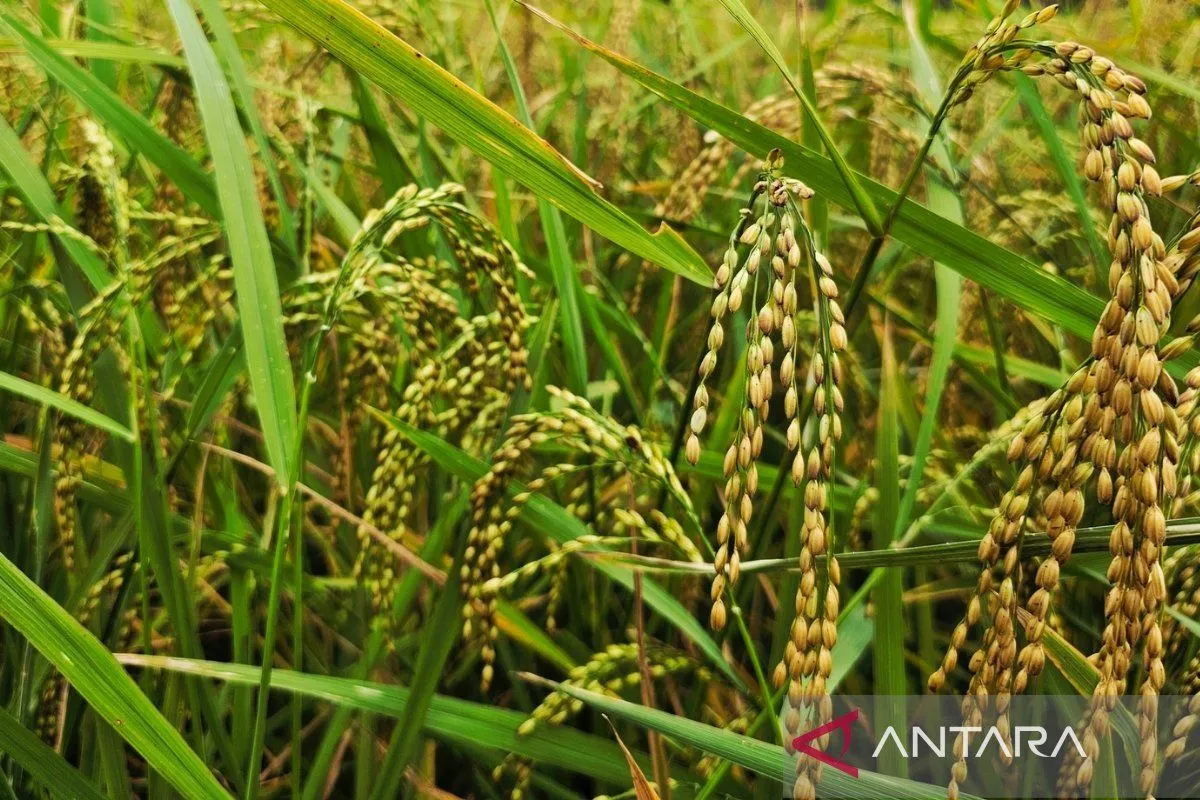
They were not there for no reason. That morning, Sebadai Ulu was preparing to record a small but meaningful piece of history: the inaugural harvest of upland rice (padi gogo), marking the first time in decades that rice had been cultivated in the village, which is part of the Bunguran Timur Laut Sub-district.
This harvest was beyond a ceremonial event. It was the result of a pilot project initiated by the Bedung Lestari Village-Owned Enterprise (BUMDes), aimed at demonstrating that their village has the potential to make a significant contribution to national food self-sufficiency.
Indeed, under President Prabowo Subianto’s administration, the Indonesian government has prioritized food self-sufficiency, with rice as the primary focus. For 2026, the government has set a target of securing 4 million tons for the Government Rice Reserves (CBP) to bolster national food security.
Among the attending officials at the historic event was Jarmin, the deputy district head of Natuna, witnessing the harvest that had a significant meaning for the future of agriculture in border areas.
In his remarks, he explained that the upland rice planting was carried out fully by using Sebadai Ulu Village's budget.
The Natuna District Government, he explained, provided support through technical assistance from agricultural instructors and pest control officers.
This support played a vital role in the initiative's success. The instructors and officers ensured that the planting methods were precise, fertilization met the specific needs of the soil, and pests were managed correctly.
Their goal was simple: to prevent crop failure and ensure the village's efforts did not end as just a one-time experiment.
The results were encouraging. From an area of roughly two hectares, the upland rice harvest is estimated to reach about eight tons of dry grain, averaging four tons per hectare. This is projected to produce approximately four tons of consumable rice.
As the symbolic harvest began, smiles were visible on the faces of everyone involved—especially the BUMDes managers and village officials. For them, this success was about more than just production numbers. Above all, this first harvest served as tangible proof that Natuna’s dry land can be optimized for farming.
This achievement also carries a social mission. The village government and BUMDes managers hope this harvest will trigger enthusiasm among other farmers in the surrounding area.
They are well aware of the Indonesian people's tendency to follow the trend. Surely, people are often inspired to try something new once they see real success right in front of them.
The hope is that more residents will find the courage to start planting rice and expand their planting area even further.
Surge in rice production
Natuna undoubtedly has a strong determination to support the national food self-sufficiency move, reflected by the district's total expanded rice planting area (LTT) throughout 2025.
The central government had previously set a target of 65 hectares for the Natuna District's LTT. However, by the end of 2025, the actual progress far exceeded that goal, reaching 102.25 hectares, or about 37 hectares higher than the target.
Based on data through November 2025, the total harvested dry grain from this area is estimated to reach 194.29 tons. This achievement proves that this border area, long known primarily as a maritime area, possesses agricultural potential that should not be overlooked.
Of course, the achievement did not come instantly; it took collaboration of various parties and governments at all levels: central, provincial, district, and village governments.
This support was provided in various forms, including agricultural infrastructure and equipment, high-quality seeds, fertilizers, machinery, drainage construction, and continuous technical assistance.
Looking at the total paddy harvest in 2025, the yield is admittedly not yet enough to meet the needs of the entire Natuna population, which reaches about 6,000 tons. Nevertheless, this achievement has firmly emerged as undeniable proof that the soil in Natuna can be used for producing rice.
Head of the Food Security and Agriculture Office of Natuna District, Wan Syazali, stated that the planting of upland rice is also currently being tested in Serasan Sub-district and Bunguran Tengah Sub-district, with a planting area of 10 hectares and 4 hectares, respectively. The results are still being awaited, with hopes that they will be just as successful as those in Sebadai Ulu.
The upland rice harvest in Sebadai Ulu Village has served as a new symbol of optimism. It shows that rice self-sufficiency is not only reserved for major agricultural hubs in Java or Sumatra; it can also flourish in border areas as long as there is political will, support, and the courage to try.
Related news: Indonesia builds foundation in becoming global food leader
Related news: Gov't targets absorption of 4 million tons of rice reserves in 2026
Related news: Indonesia achieved rice self-sufficiency as of December 31, 2025
Translator: Muhamad Nurman, Raka Adji
Editor: Azis Kurmala
Copyright © ANTARA 2026