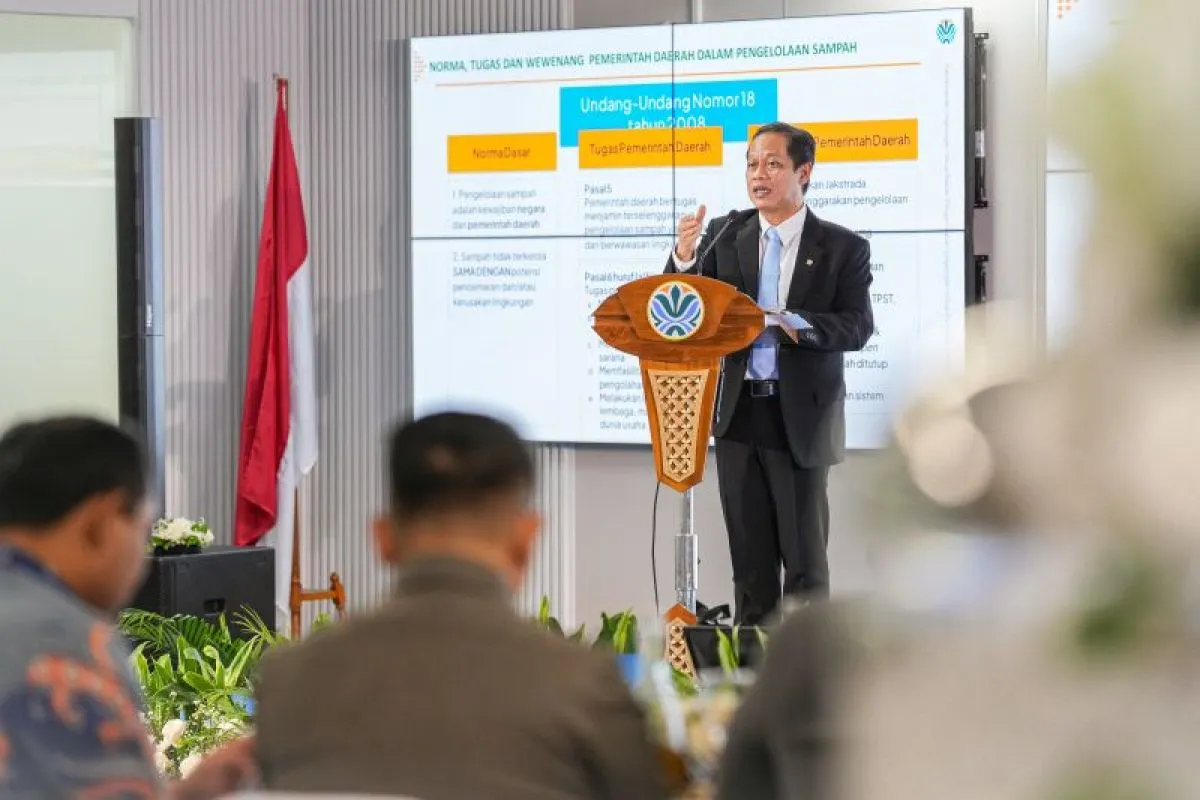
In a statement confirmed in Jakarta on Thursday, Hanif said conditions on the ground show that many districts and cities have been unable to keep pace with the volume of waste generation, which has reached 143,824 tonnes per day.
“Our national target is very clear: 100 percent of waste managed by 2029. However, in reality, only around 24 percent is currently being properly managed. This is a red flag indicating that the waste problem can no longer be borne by the central government alone,” Hanif said.
“Political courage and strong synergy from regional governments, particularly local legislatures, are needed to deliver concrete solutions in their respective areas through community empowerment and the transformation toward a circular economy,” he added.
Speaking at a National Coordination Meeting on Environmental Policy with DPRD members from across Indonesia in Jakarta on Tuesday (Jan. 14), Hanif explicitly declared a national waste emergency as part of the response to what he described as the three planetary crises.
Hanif reiterated that Law No. 18 of 2008 on Waste Management grants full authority to regional governments to develop innovative waste management approaches.
He urged local legislatures not to hesitate in strengthening regional regulations, allocating sufficient budgets, and tightening oversight of zero-waste policy implementation at the grassroots level.
At the same event, Siswanto, chairman of the Association of District Legislative Councils of Indonesia (ADKASI), expressed appreciation for the ministry’s initiative while acknowledging structural challenges at the regional level.
He said environmental issues, particularly waste management, have often been sidelined in regional budgets in favor of physical infrastructure development.
However, through intensified coordination with the Ministry of Environment and BPLH, he said ADKASI is committed to repositioning budget policies at the district level to better support environmental sustainability.
“This forum marks a turning point for us in local legislatures to provide full support. We are ready to strengthen our legislative and oversight functions to ensure circular economy policies are implemented at the regional level, so that waste is no longer seen as a budgetary burden, but as a resource with economic value for communities,” Siswanto said.
Related news: Indonesia to begin 34 waste-to-energy projects, Prabowo says
Related news: Indonesia pins hopes on waste-to-energy to ease landfill crisis
Related news: Ministry to take legal action against regions failing to handle waste
Translator: Prisca, Azis Kurmala
Editor: M Razi Rahman
Copyright © ANTARA 2026