There, he could no longer see his rice field. Roads, irrigation channels, and rice fields—once filled with golden stalks ready for harvest—had all been leveled into a vast expanse of mud.
"I cried. I was only five days away from harvest when the flood hit," he told ANTARA on January 24, 2026, as he recalled the devastating floods.
The November floods and landslides that struck three provinces of Sumatra–Aceh, North Sumatra, and West Sumatra–have turned the local residents' lives upside down. Although the water has receded, the aftermath of the disaster still weighs heavily on residents.
They not only lost their belongings but are also facing the threat of losing their livelihoods—especially farmers like Ishak.
Based on data from the Ministry of Agriculture, the total area of rice fields damaged by the disasters in Sumatra reached 98,002 hectares.
Aceh is the province that incurred the most extensive damage, with 54,233 hectares of rice fields across 21 districts and cities, followed by North Sumatra with 37,318 hectares across 15 districts and cities, and West Sumatra with 6,451 hectares across 14 districts and cities.
For Ishak, farming is his family's lifeline. He has worked as a tenant farmer on a 9,200-square-meter plot of land for decades. A single harvest can yield up to 2.5 tons of dry husked rice. Yet, his dream of profiting from the current grain price of Rp6,000 (around US$0.36) per kilogram has vanished.
Nevertheless, in mid-January, the central government, through the Ministry of Agriculture, launched the Sumatra Post-Hydrometeorological Disaster Rice Field Rehabilitation Program.
President Prabowo Subianto has instructed that the program be labor-intensive by involving the farmers, allowing them to continue earning an income during the rice field recovery process.
The government is deploying heavy equipment to clear mud from irrigation systems. Meanwhile, the damaged rice fields will be repaired by the owners or tenant farmers themselves, with costs covered by the central government.
The rehabilitation is being carried out in stages, starting with fields classified as having light to moderate damage. This includes 6,530 hectares in Aceh, 6,593 hectares in North Sumatra, and 3,624 hectares in West Sumatra.
In total, the rehabilitation covers 13,708 hectares across the three provinces, with the work targeted to run from January through February 2026.
New hope
The impact of the rice field rehabilitation program is now becoming apparent, with clean water flowing smoothly from the irrigation channels, reviving hope among farmers in the Pinto Makmur Village.
Ishak and his son have begun to cultivate their field again, using wooden hoes. For the first step, they had to reshape the embankments. Fresh rice will be planted directly into the mud left behind by the floods that destroyed their previous harvest.
However, the task is not easy since the mud is now a meter deep. They must work entirely by hand, as the deep mud makes it impossible to use a tractor.
"Before the floods, the mud in the fields was only calf-deep. Now, it reaches my waist," Ishak said.
Despite the struggle, he feels a sense of relief because the government has promised to cover the costs of the rice field rehabilitation, allowing him to invite more local residents to work as farm laborers.
Since the work has become so much more difficult, wages for a half-day of work have risen to Rp60,000, up from the previous rate of Rp50,000. Ishak admitted that if he had to provide the capital out of his own pocket, he would not be able to afford it.
"The government promised to pay the workers. Once they finish their tasks, they must take a picture as proof," he said.
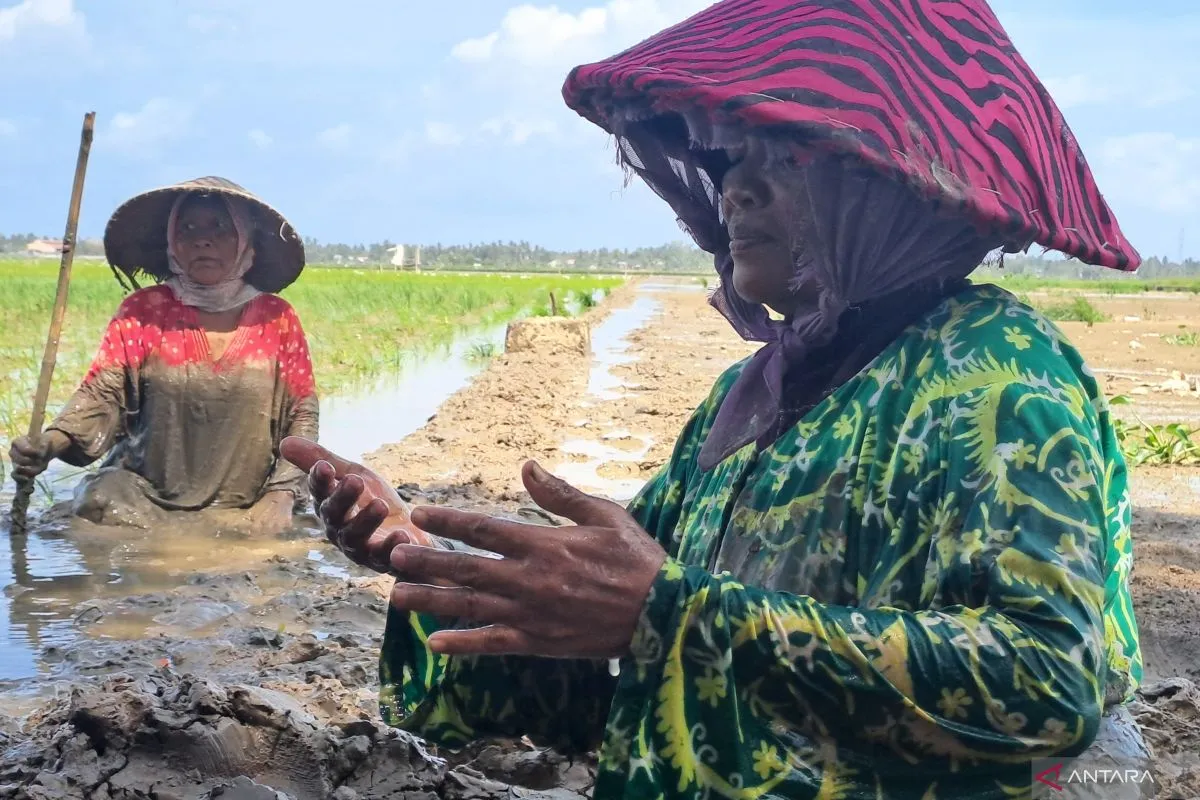
Working in deep mud is no easy feat. Khairu Rahmi, another farmer in Pinto Makmur Village, stood in her field holding a length of string stretched across the plot for nine female farm laborers who were busy planting rice. The string is used as a guide to ensure the rows are straight and neatly aligned.
This is the first planting to be carried out on this plot since the November disaster. At a glance, the work looks effortless: their hands move with practiced speed, precisely planting each seedling one by one.
However, a closer look reveals the struggle: half of their bodies are submerged in the thick mud. Simply moving backward to plant the next row requires immense effort from these women.
"People think we are working while sitting down, when we’re actually standing deep in the mud," Rahmi said.
She noted that she is able to plant again thanks to government seed assistance, which is provided to farmers based on the size of the fields they cultivate.
Rahmi herself received 10 kilograms of seeds to plant rice on a 4,000-square-meter field.
The sun was overhead by the time the women finished their work. They gathered in a row, sitting together as they washed the mud from their bodies, sharing a laugh and tea.
For these farmers, the rice field rehabilitation program has created new hope to rebuild their livelihoods and continue their lives through farming after the devastation of the floods.
Related news: Indonesia accelerates access, housing recovery in flood hit East Aceh
Related news: Health Minister targets full recovery in Sumatra flood zones by March
Related news: BNPB completes temporary shelters for flood victims in Pidie Jaya
Translator: FB Anggoro, Raka Adji
Editor: Azis Kurmala
Copyright © ANTARA 2026


