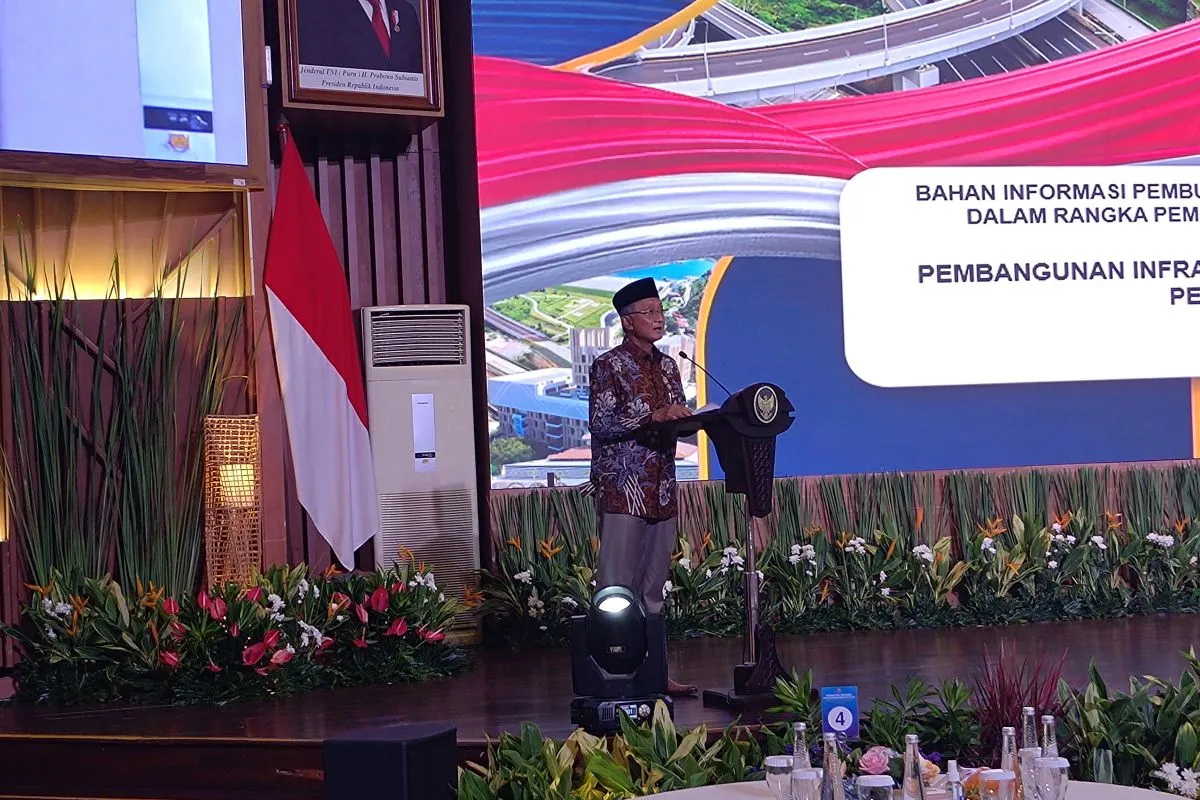
As part of supporting the national priority programs (Asta Cita), Public Works Minister Dody Hanggodo emphasized his ministry’s role in providing basic infrastructure that supports economic activity and public services.
According to him, the ministry is implementing a strategic program called PU 608 with three main targets, including investment efficiency or an incremental capital output ratio (ICOR) below 6, poverty alleviation towards zero percent, and economic growth reaching 8 percent by 2029.
“These are the main parameters for ensuring that infrastructure development contributes directly to national economic performance,” he said on Thursday.
He stated that these achievements will be measured through national economic indicators, including the contribution of infrastructure development to productivity and job creation.
In 2026, the ministry is managing a budget of Rp118.5 trillion (almost US$7 billion) to implement several priority programs.
These programs include the construction of a new irrigation network covering 16,000 hectares, the ongoing construction of 12 dams, and the provision of raw water at a rate of 2 cubic meters per second.
In the connectivity sector, the government is targeting the construction of 102 kilometers of new roads and the improvement and preservation of 1,500 kilometers of roads, including the construction of 33 kilometers of toll roads.
Meanwhile, in the housing sector, the government is targeting an increase in the capacity of the drinking water supply system by around 800 liters per second and sanitation services for 63,000 families.
In the strategic infrastructure sector, the government is also preparing to build around 900 public schools and rehabilitate 1,000 religious schools.
For 2027, the Ministry of Public Works is targeting a number of more measurable outcome indicators, including increasing water storage capacity and improving irrigation reliability.
“In the water resources sector, for example, the target is to increase storage capacity to 58.84 cubic meters per capita and irrigation reliability to increase by 27 percent,” Dody remarked.
In the connectivity sector, the government is targeting a reduction in travel time on major national routes, while in the housing sector, access to safe drinking water is targeted to reach 33.46 percent, and safe sanitation to reach 10.8 percent.
Dody emphasized that infrastructure development focuses not only on physical output but also on its impact on improving productivity and the community’s quality of life.
Related news: Indonesian minister urges priority Infrastructure push in Papua
Related news: Minister AHY to directly review Sumatra disaster recovery on Jan 22
Related news: Infrastructure Ministry sends 250 tonnes of disaster relief to Sumatra
Translator: Aria Ananda, Yashinta Difa
Editor: Azis Kurmala
Copyright © ANTARA 2026


