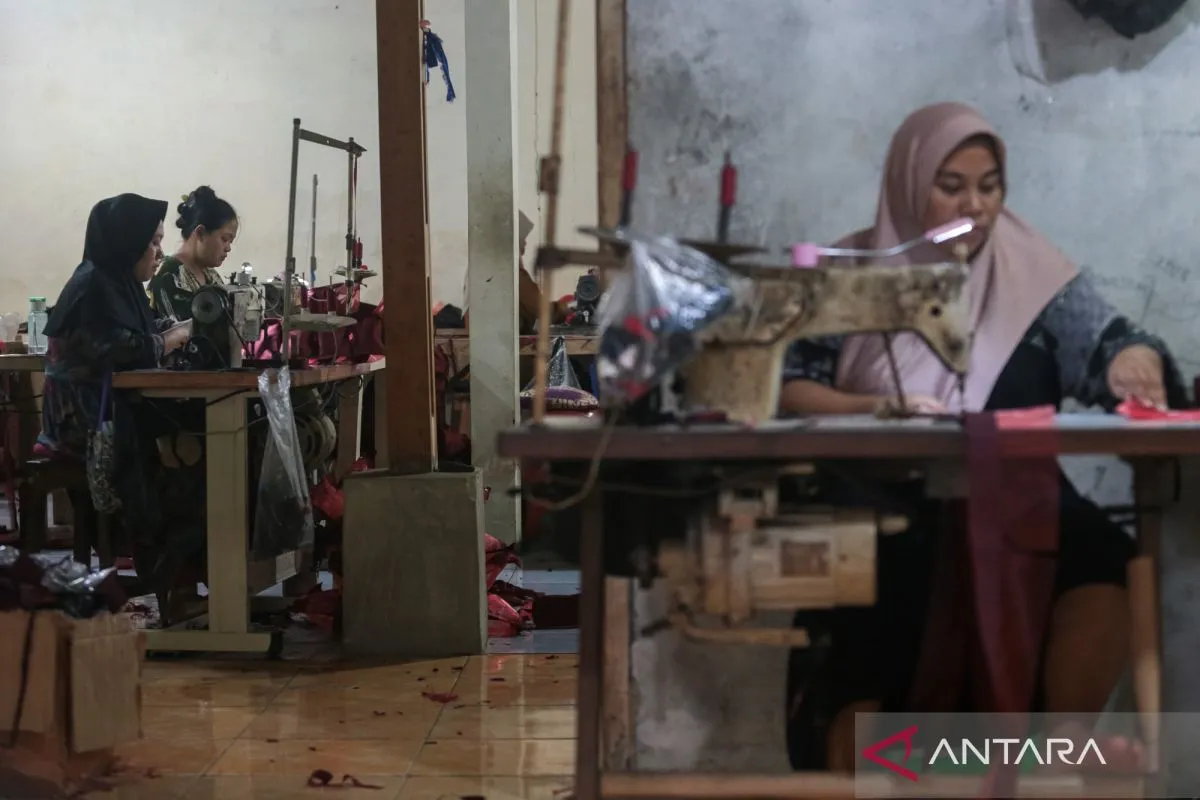
Villages now occupy a complex position: on one hand expected to become new growth engines, while on the other required to support the national economy..Jakarta (ANTARA) - In many developing countries, economic transformation often begins in cities and then gradually spreads to the periphery. Indonesia, however, is beginning to show a slightly different pattern.
Amid increasingly complex global pressures, from energy uncertainty to supply chain tensions, villages are instead being positioned at the forefront of the architecture of national economic resilience.
This shift is not driven by a single policy, but rather by an accumulation of changing perspectives: that economic resilience is not only determined by the strength of industrial centers, but also by the stability of the economic base at the lowest level.
Within this framework, villages are no longer in a passive position. They are increasingly treated as productive spaces with strategic functions, not only for equity, but also for the stability of the broader economic system.
However, behind this big narrative, a more fundamental question arises: are villages truly being empowered as a new economic engine, or are they being placed under a heavy burden of policy expectations?
Logic of rural production
For a long period, rural development in Indonesia has followed a relatively simple logic: redistribution.
Infrastructure was improved, access was expanded, and basic services were strengthened.
Villages were positioned as recipients of the benefits of growth that primarily occurred in cities and industrial centers.
However, in recent years, this logic has begun to shift. Villages are no longer only expected to develop in terms of infrastructure, but also to generate economic value.
Through various fiscal policy instruments, including the Village Fund, villages are encouraged to enter production sectors such as food systems, local economies, and the strengthening of business institutions.
Villages are no longer positioned as spaces of development consumption, but as economic production units expected to support part of national needs, especially in the food sector.
In the context of global uncertainty and supply chain pressures, this development direction can be understood as a rational strategy to strengthen resilience from within.
On the other hand, this shift also transfers some part of economic burden to the local level. Villages are now not only policy recipients, but also part of the national economic buffer system.
They are expected not only to grow, but also to absorb pressures, whether from price fluctuations, logistics distribution, or domestic market dynamics.
However, not all villages have the same capacity to transform from administrative areas into productive economic units. Infrastructure gaps, human resource quality, and institutional capacity cause this process to progress unevenly.
Some villages are able to adapt more quickly, leveraging road access, market connectivity, and policy support to expand economic activity. However, others remain in a slower transition phase, where development programs have not yet fully translated into real economic impact.
Digitalization and rural institutions
If the shift toward production forms the new foundation, digitalization emerges as an acceleration tool expected to strengthen this transformation.
Digitalized villages are seen as new spaces where efficiency, transparency, and market expansion can occur simultaneously.
In theory, digitalization promises to shorten the distance between villages and markets. Local products no longer rely entirely on traditional distribution chains. Public services become faster, and information flows more openly.
However, in practice, digitalization does not automatically equalize opportunities. It instead reveals sharper differences in readiness between regions.
Villages with better infrastructure and digital literacy move faster, while others remain in the early stages of adaptation.
In this regard, village economic institutions such as Village-Owned Enterprises (BUMDes) are positioned as key connectors between local potential and bigger markets.
However, on the ground, institutional capacity does not grow as quickly as policy design. It requires strong governance, managerial capability, and a supportive market ecosystem. Without these, village institutions risk being formal structures with limited economic function.
This condition shows that the main challenge of rural economics is not merely the availability of programs or budget size, but the quality of the ecosystem that supports the implementation.
Without comprehensive strengthening, digitalization and institutions may become instruments that are not effective in driving transformation.
Villages now occupy a more complex position: on one hand expected to become new growth engines, while on the other required to support the national economy from below.
However, the greater the "role" assigned, the more important it becomes to reassess whether existing capacity is enough to meet such expectations.
Without equivalent strengthening, village transformation may only create new gaps between villages that are able to enter the modern economy and those that lag behind in the same transition process.
In the long term, such disparities may affect the economic stability that rural development seeks to achieve.
At this point, the most important question is no longer whether villages should be part of the national economy, because that is already happening.
The question is whether the current policy architecture is realistic enough to make villages truly engines of transformation, rather than merely passive buffers of a system that is still finding for its own balance.
Related news: Indonesia plans 5,000 export villages to boost rural economies
Related news: Indonesia targets 30,000 village cooperatives to boost rural economy
Related news: Reverse migration to cities seen risking demographic dividend: BKKBN
Editor: M Razi Rahman
Copyright © ANTARA 2026


