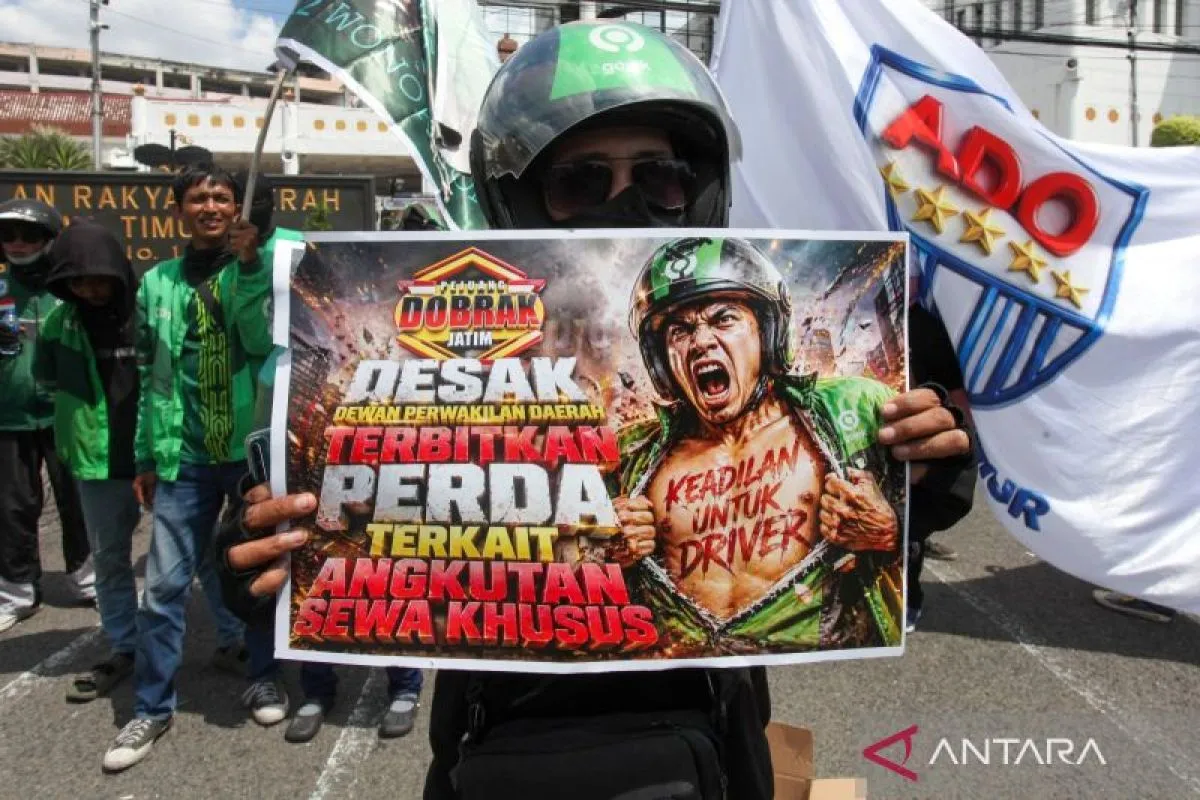
The provision, formally titled Presidential Regulation No. 27 of 2026, was crafted to overhaul how earnings are shared between drivers and app operators, shifting away from a system long dictated by market dynamics and corporate policies.
Addressing about 200,000 unionized laborers during his 2026 May Day speech at the National Monument in Jakarta, President Prabowo Subianto unveiled the rule to counter disproportionate income sharing.
Addressing about 200,000 unionized laborers during his 2026 May Day speech at the National Monument in Jakarta, President Prabowo Subianto unveiled the rule to counter what he described as disproportionate income sharing, where operators claimed 10 to 20 percent of per-ride earnings.
Through the new regulation, Prabowo pledged that drivers would stand to keep at least 92 percent of each transaction’s value, a move he framed as restoring fairness to the young yet progressive industry.
Beyond pay proportions, the measure extends to obliging companies to provide social protection coverage, ensuring their drivers gain access to health and accident insurance.
The regulation’s sweeping scope underscores the government’s recognition of ojol as part of the nation’s labor force deserving safeguards equal to other workers.
Adding weight to the shift, the government moved quickly to secure a foothold in ride-hailing services, aiming to stimulate change from within the industry itself.
The investment management agency Danantara, Indonesia’s sovereign wealth fund, stepped in by acquiring stakes in certain online taxi companies, as revealed by House of Representatives (DPR) Deputy Speaker Sufmi Dasco Ahmad during May Day celebrations.
Without naming any firm, Dasco said the investment was rooted in efforts to improve drivers’ welfare, pressing operators to adjust corporate policies until their per-transaction levy is capped at eight percent.
Rosan Roeslani, chief executive officer of Danantara and serving concurrently as minister of investment, later confirmed the policy by announcing the government’s entry into GoTo, the major tech firm behind Gojek, widely regarded as the pioneer of Indonesia’s online taxi industry.
Though he did not specify the size of the stake, the CEO explained that the plan is to gradually secure larger shares, signaling a long-term commitment to reshaping the sector from within to serve public interests.
These intertwined moves reshape the balance of power between government, digital platforms, and millions of drivers, pulling the state into the heart of the ojol economy.
Still, the promised reform drew cautious industry responses. Gojek quickly broke silence with a pledge to study the regulation’s details and its impact on financial calculations, incentive programs, and service strategies.
While voicing openness to government talks, Grab, another ojol platform, stressed the importance of serving consumers with attractive fares to sustain business.
Both accounts signal the need for a balanced approach, improving drivers’ welfare without shaking the industry’s foundation.
After all, reducing commission fees is unlikely to boost drivers’ income overnight. This policy could instead trigger cuts in trip subsidies, altered incentives, and fare adjustments.
Given that online taxi services often win consumers with attractive promotional fares, lowered subsidies and incentives could drive up fees. Higher fares risk pushing passengers away, ultimately eroding drivers’ total earnings rather than increasing them.
Ensuing worries extend to platforms’ fiscal space, particularly since they rely heavily on sustained capital inflows to keep services running through technological development, security systems, and customer support. Put simply, shrinking commission fees will compel companies to review their budgeting and investment priorities.
The Indonesian Digital Mobility and Delivery Industry Association (Modantara) noted that the new yield-sharing framework for ojol falls below global commission averages of 15 to 30 percent for similar services.
The association warned the lower margin could dampen investor appetite for Indonesia’s digital economy, which is increasingly fueled by online ride-hailing services anchored in millions of drivers and other gig workers alike.
Service operators may resort to an array of measures to adapt to the commission-capping regulation, but questions remain about potential gaps in adaptability.
Resilient companies with stronger financial capacity are likely to navigate imminent changes more efficiently than those less equipped. This imbalance, in turn, could distort competition across the industry.
Aside from yield recalculations, the new presidential regulation has revived talks surrounding the long-contested employment status of drivers. Ride-hailing companies still regard them as partners rather than employees, though voices demanding change are growing louder within the ojol community.
The government, as DPR Deputy Speaker Dasco put it, is weighing possible solutions and has assured drivers they will be included in brainstorming.
Factoring in drivers’ aspirations is essential to ensure a fair policy.
This debate matters because reclassifying drivers could reshape company prerogatives while binding them to new protections.
On one side, firms could demand higher compliance with work standards from drivers, as they do from regular employees; on the other, they would also be obliged to deliver health and accident benefits, as already mandated by the regulation.
The regulatory change signals a shift in the government’s approach to the ojol industry. No longer content with broad policy oversight, the state is moving deeper into operational details once left to corporate discretion, strengthening its role in shaping the trajectory of Indonesia’s digital industry to better safeguard informal laborers.
Implementation outcomes will hinge on monitoring and coordination among stakeholders.
Fare adjustments, incentive schemes, and social protection require the government, companies, and driver communities to be on the same page to avoid missteps and repercussions. Any change in one component could ripple through the interconnected, tech-driven economic landscape.
In the short term, the policy’s impact will be evident in income structures and operating costs. Over time, effects may extend to consumption patterns, corporate strategies, and investment dynamics across the digital economy.
These factors add up to determine the future of Indonesia’s ride-hailing industry in the wake of the eight-percent commission cap.
Related news: Danantara Indonesia buys into GoTo, aims for larger share
Related news: May Day: Prabowo caps ride-hailing commissions at 8 percent
Editor: Arie Novarina
Copyright © ANTARA 2026


