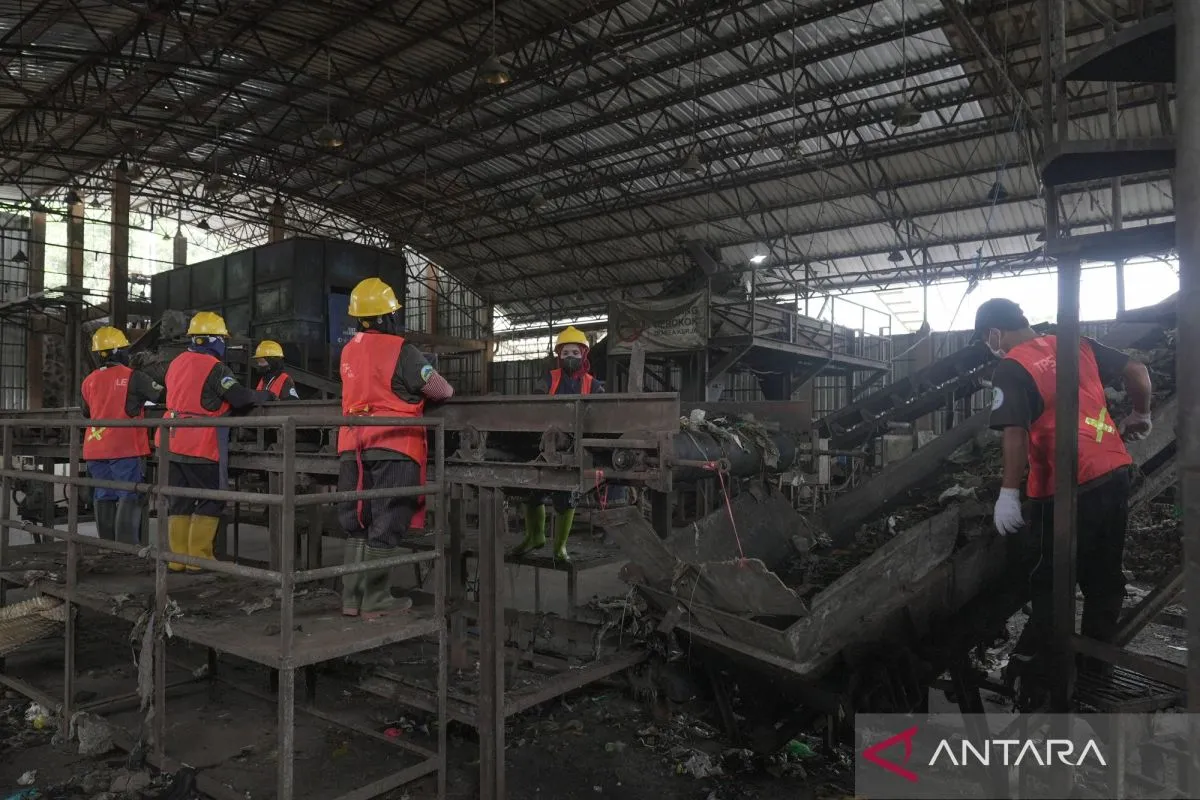
The waste is moved by a conveyor belt to a larger machine, where it is separated into organic and plastic materials through a rapid spinning process.
In another area of the facility, black fly larvae convert food scraps such as rice and vegetables into animal protein. Plastic waste, meanwhile, is shredded and melted before being molded into roof tiles and paving stones.
President Prabowo Subianto reviewed these processes at the Wlahar Wetan Integrated Environmental and Educational Waste Processing Facility (TPST BLE) in Banyumas District, Central Java, in late April.
"Waste, waste management, is now a national priority. In two or three years, we must control waste throughout Indonesia," Prabowo emphasized at that moment.
His statement was related to this mounting environmental issue. He emphasized that waste management has been designated a national priority that requires systematic handling, and that the Banyumas model, which successfully reduced waste by 80 percent before it reaches final processing facilities, will serve as a blueprint for national implementation.
In 2024, Indonesia produced 27.74 million tons of waste, equivalent to 76,000 tons per day, highlighting the growing volume of waste generated each day and the inadequacy of the current waste management system.
The "collect-transport-dump" model, which has become the norm for waste management workers in almost all regions, has left most landfills (TPA) overloaded.
The composition of national waste further complicates the problem. Data from the National Waste Management Information System (SIPSN) shows that the proportion of plastic waste has increased from 15.88 percent in 2019 to 19.65 percent in 2024.
Plastic is difficult to decompose, and low-quality plastic is often not accepted by conventional recycling industries. In many cases, it eventually ends up polluting the ocean.
Indonesia is currently listed as one of the world's largest contributors of marine plastic waste. The government is responding to this situation with an ambitious target: to control the waste problem by 2029 with a zero waste concept.
The BLE Waste Processing Plant (TPST BLE) in Banyumas exemplifies integrated waste management, encompassing infrastructure, technology, communities, and markets, all integrated into a single, mutually supportive system.
The core of this model is the TPST, which is decentralized and operated at the sub-district and village levels by Community Self-Help Groups (KSM). At the Kedungrandu TPST, for example, this facility serves more than 3,100 customers with a processing capacity of 15 tons per day.
The key to its efficiency is an automatic waste-sorting machine known as a “gibrik” machine. This locally developed innovation replaces manual sorting by separating organic and inorganic waste at high capacity through a more hygienic process.
Inorganic waste, particularly low-value residual plastics like plastic bags and packaging wrappers that cannot be recycled conventionally, is directed to the Refuse Derived Fuel (RDF). This process involves sorting, shredding, and biological drying until the waste reaches sufficient calorific value to be used as industrial fuel.
Waste Processing Products
The Banyumas BLE Waste Processing Plant (TPST BLE) is targeting a daily RDF production of 157.5 tons, with a fixed buyer already secured: the PT Solusi Bangun Indonesia (SBI) cement factory in Cilacap, which uses RDF as a coal substitute in its cement kiln.
For organic waste, the approach involves cultivating black fly larvae, or maggots. Food scraps are used as food for the larvae, which are then harvested as protein for animal feed. The digestive residue, known as kasgot or maggot excrement, becomes organic fertilizer sold to farmers.
These measures formed a circular economy, with leftover food from the dinner table returning to the fields as fertilizer to produce new food.
During the visit, President Prabowo’s attention was drawn to the most visible outputs of the model: roof tiles and paving blocks made from recycled plastic. These products help address the long-standing challenge of low-value plastic that is difficult to recycle through conventional systems.
Flexural load test results show that these plastic composite roof tiles exceed the minimum requirements of SNI 0096:2007, with a maximum flexural load of 6,355.31 Newtons, meaning that these tiles are safe to use.
The price ranges from Rp7,000 to Rp8,000 (US$0.39–0.45) per unit. The government plans to integrate them into the national home improvement assistance program, with a budget of around Rp20 million (US$1,118) per unit. An allocation of Rp4 million to Rp5 million (US$223–279) is allocated for roof tile components. This program will also open a massive market for regional circular products.
The decision to use the Banyumas model as a national blueprint was also driven by a careful cost calculation. Building a modular RDF facility similar to the one in Nambo, West Java, requires an investment of around Rp600 billion (US$33.5 million), far more affordable than the Legok Nangka Waste-to-Energy Power Plant (PLTSa) project in Bandung District, which could reach Rp4 trillion (US$223 million).
PLTSa is indeed efficient, simply burning waste to boil water, which then drives a turbine to generate energy.
But such a concept is only feasible for metropolitan cities with waste generation exceeding 1,000 tons per day. For districts with much smaller production, modular RDF and integrated waste management systems (TPST) like those in Banyumas are a more realistic option, including for carbon trading schemes.
The Ministry of Environment and the Ministry of Public Works and Public Housing (PUPR) are said to be coordinating the replication of this model. The technology used is available in the government procurement e-catalog, does not require extensive land, and is largely based on local innovation, rather than high-tech, which relies on imported components.
Challenges
Behind these promising figures, a series of structural obstacles cannot be ignored.
Budget-wise, the average regional allocation for waste management is only 0.64 percent of the regional budget (APBD), far below the figure needed to ensure the sustainable operation of cooperatives (KSM) and the maintenance of industrial-scale machinery.
Furthermore, some upstream problems cannot be solved by expanding the number of TPSTs.
Environmental organizations like WALHI and Greenpeace warn that thermal technologies like RDF could be a false solution if plastic producers are not held accountable through the Extended Producer Responsibility (EPR) policy, a scheme that places the burden on plastic producers to produce more environmentally friendly products.
As long as plastic continues to be produced in large volumes without upstream accountability mechanisms, downstream processing infrastructure will continue to be overwhelmed.
The social challenges are no less significant. The culture of throwing away waste without sorting it remains prevalent in most Indonesian households. Without this behavioral change, even the most sophisticated garbage disposal machine will still receive mixed waste, slowing down the entire processing process.
The Banyumas model is proof that the circular economy is not an abstract concept. The system is already running, generating revenue and creating jobs at the community level.
The visit by the President further underscores a strong political signal of government commitment and direction.
However, the real test of this commitment lies not in the Banyumas TPST, but in hundreds of other districts and cities with diverse geography, waste characteristics, fiscal capacity, and community readiness.
The 2029 target is possible, but the difference between the blueprint and conditions on the ground is often larger than documented plans suggest.
Related news: Jakarta begins massive waste sorting movement this Sunday
Related news: Indonesian Army partners with government to tackle waste issues
Related news: Indonesia eyes plastic roof tiles for public housing upgrades
Translator: Aditya Ramadhan, Resinta Sulistiyandari
Editor: Azis Kurmala
Copyright © ANTARA 2026


