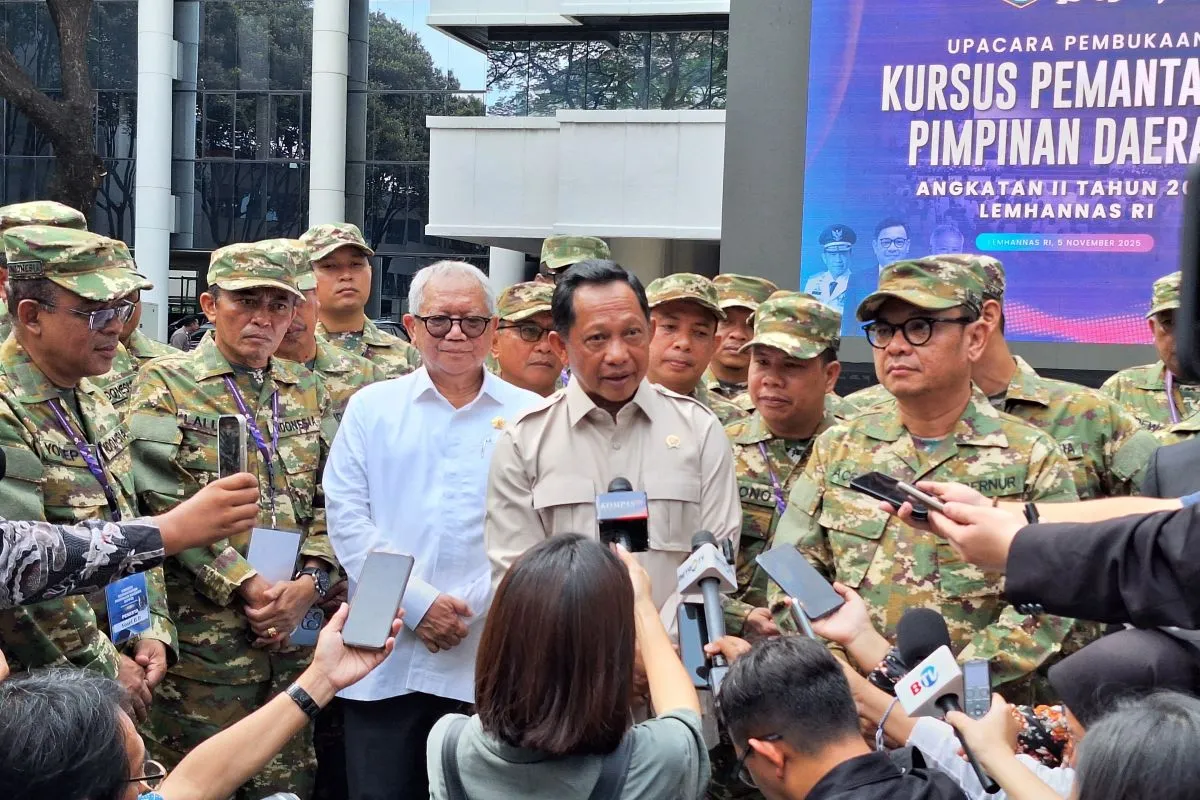
“We realize that there is a need to enhance the capabilities of regional leaders. Given that our governance principle is semi-decentralized, where certain powers are delegated to the regions, this is essential,” Tito said during the opening of the 2025 Second Wave KPPD at the Lemhannas office in Jakarta on Wednesday.
the Second Wave of the Regional Leadership Enhancement Course (KPPD).organized by the National Resilience Institute (Lemhannas) of the Republic of Indonesia.
The minister emphasized that regional leaders play a central role in managing governance within their respective regions, especially in a country as vast and administratively complex as Indonesia.
Tito compared Indonesia to other large countries like China, India, and the United States, which have land-based governance structures with relatively fewer challenges. Indonesia’s status as an archipelagic nation, he noted, presents unique difficulties in governance.
"As an archipelago, with communities spread across islands, mountains, valleys, and more, governing becomes much more challenging. Much of this authority is entrusted to the regions. Regional leaders have the power to issue regulations, including regional head regulations, whether from governors, mayors, or district heads,” Tito explained.
This policy has a direct impact on society, which is why the capability of regional leaders needs constant strengthening. Tito added that elected regional leaders come from diverse backgrounds, not only from the bureaucracy but also from business, entertainment, and the arts.
“Thus, they require specific leadership skills to create policies that serve their communities. Our society is one of the most complex in the world,” he said.
The Home Minister also outlined four types of societies which are information-based, industrial, agricultural, and pre-agricultural (isolated). Indonesia contains all of these societal types, which means that regional leaders must possess both managerial and technical skills to address these varied needs.
"One of the key training packages to strengthen national insight and managerial skills will be conducted in classes, particularly at Lemhannas, followed by technical governance training at the Human Resource Development Agency (BPSDM) of the Ministry of Home Affairs,” Tito added.
Additionally, participants will engage in study programs at the Lee Kuan Yew School of Public Policy in Singapore. They will delve into critical thinking about the factors that contribute to successful public services in Singapore and examine practices that can be applied in their own regions.
This experience is expected to inspire regional leaders, encouraging them to foster innovation and creativity within their respective areas upon their return.
Related news: Indonesia taps Australia model to boost local governance policy skills
Related news: Innovation should deliver solution, not just image-building : Official
Translator: Fianda, Azis Kurmala
Editor: Primayanti
Copyright © ANTARA 2025


