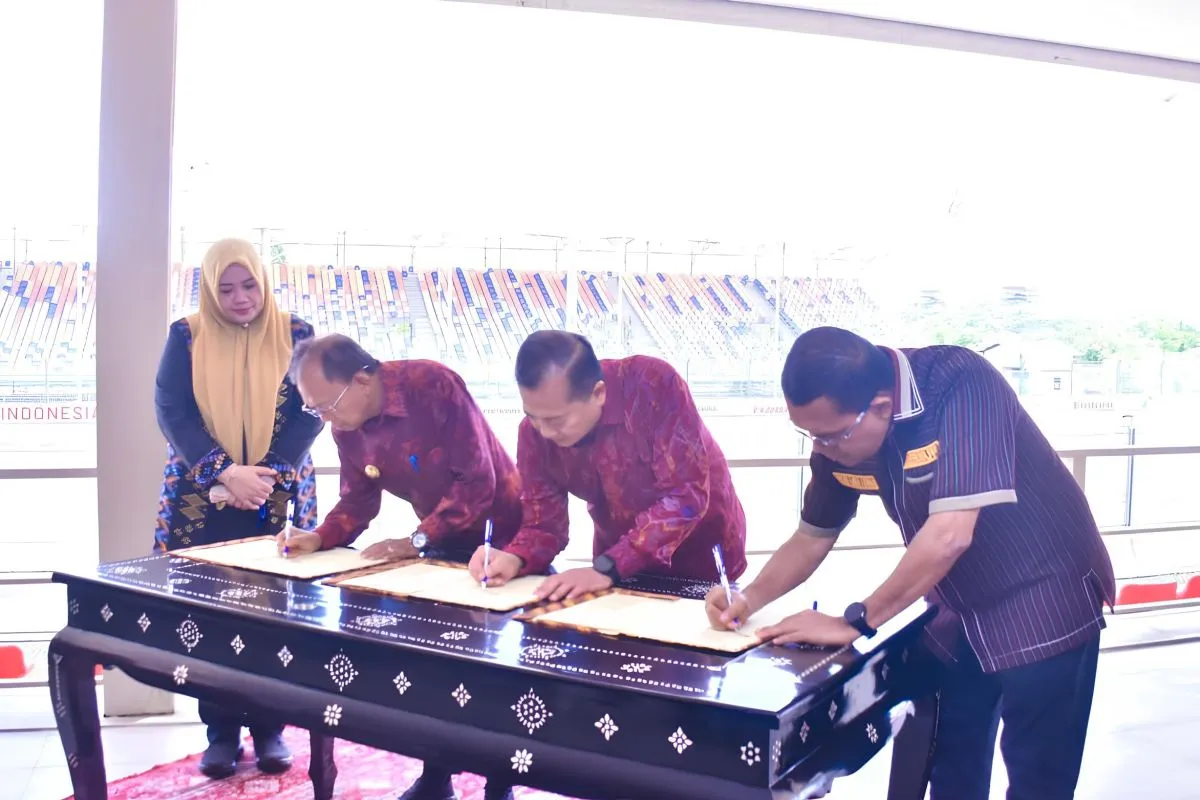
The gentle northwestern breeze blowing along the coast of the Mandalika Circuit brings new hope for greater success after 67 years of going it alone.
The memorandum of understanding signed by the governors of the three provinces seeks to rekindle the spirit of togetherness to build a strong, solid, and sustainable regional foundation.
In the future, the dominance of market makers, so closely associated with Bali, will likely decline. At the same time, NTB and NTT will not only benefit from the added value or spillovers generated by the various economic activities expanding in Bali.
The Regional Cooperation between Bali, West Nusa Tenggara, and East Nusa Tenggara (KR-BNN) is a strategic initiative to dispel the thick fog of power relations that have developed for decades in the Lesser Sunda Islands.
West Nusa Tenggara Governor, Lalu Muhamad Iqbal, stated that Bali, West Nusa Tenggara, and East Nusa Tenggara share many connections and similarities, both historically, sociologically, demographically, ecologically, and even geologically.
The similarities underpin regional cooperation so that the small island regions can progress and develop together.
The cross-regional collaboration agreement focuses on five main sectors: tourism, transportation or connectivity, renewable energy, regional trade, and commodity exports.
West Nusa Tenggara and East Nusa Tenggara are no longer complementary actors to Bali, but rather key actors in regional cooperation among the three Lesser Sunda Islands regions.
Regional economic showcase
For the international community in the 18th century, the Lesser Sunda Islands were a strategic economic region and an important trading center, especially during the Dutch colonial era.
The main gateway to the Lesser Sunda Islands was Buleleng Harbor in Singaraja City, Bali. The colonial administration built various facilities, from docks, warehouses, terminals, and customs offices, in the harbor area, which began construction around 1846.
Singaraja City served as the capital of the Lesser Sunda Islands during the independence period.
Law No. 64 of 1958 concerning the formation of a new province meant that the Lesser Sunda Islands ceased to be a unified entity, splitting into Bali, West Nusa Tenggara (NTB), and East Nusa Tenggara (NTT).
Since then, Bali, which had been known to the world for centuries through Buleleng Harbor -- which served transcontinental maritime trade -- has resulted in uneven development of the three regions after the expansion.
Bali's popularity has led to increased visits from tourists, traders, and investors. Meanwhile, NTB and NTT, which share similar historical, ecological, and geographical ties with Bali, are often perceived as merely buffer zones.
Bali Governor, I Wayan Koster, stated that the regional cooperation aims to continue the historical ties that led to the birth of the Lesser Sunda Islands and create a profitable economic scheme for Bali, NTB, and NTT.
The regional cooperation (KR-BNN) is a solution to widen the region's economic gateways, allowing for faster distribution of goods, easier cross-destination travel for tourists, and a more diverse and competitive workforce across regions.
The official implementation of the collaboration will begin in 2026, establishing the Lesser Sunda Islands as a national tourism superhub, a center for the maritime resource-based blue economy, and generating significant economic growth.
On paper, the collaboration between the three provinces promises regional economic integration. As a result, Bali will no longer progress alone, but will embrace NTB and NTT to advance together through inclusive socio-economic development cooperation.
Facing climate challenges
The geographical characteristics of Bali and Nusa Tenggara, consisting of small islands and coastal areas, make them highly vulnerable to the impacts of climate change, including sea level rise, extreme weather, and the risk of tidal flooding.
Regional cooperation provides a platform for local governments to collaborate on climate challenges through sustainable tourism management, green energy, and climate-resilient infrastructure development.
The Lesser Sunda Islands' location in the southern hemisphere makes Bali, NTB, and NTT vulnerable because they are located in one of the world's most fertile centers for tropical cyclone growth.
Climate change, which warms sea temperatures, has the potential to make tropical cyclones more frequent and stronger. This poses a significant threat to Bali and Nusa Tenggara going forward.
In April 2021, Tropical Cyclone Seroja, with maximum winds of 140 kilometers per hour, caused flooding in several areas of East Nusa Tenggara. The tropical storm killed 272 people and left 102 missing.
The regional cooperation (KR-BNN) should not only strive to advance economic aspects and develop human resources, but also build a joint early warning and risk management system to be prepared for future natural disasters.
East Nusa Tenggara Governor, Melkiades Laka Lena, believes regional cooperation can strengthen leading sectors to complement each other, thus optimizing economic potential while addressing climate challenges in Indonesia's southern islands.
Electricity sourced from solar radiation, ocean waves, and water currents flowing from dams is key to addressing the future impacts of climate change.
Bali's electricity, which has been supplied from Java - predominantly fossil fuels -- is being shifted to renewable energy supplied by NTB and NTT through an underwater power grid connection.
NTB has a total renewable energy potential of 13,563 megawatts (MW), consisting of 298 MW from bioenergy, 32 MW from municipal waste, 2,605 MW from wind, and 10,628 MW from solar power.
Meanwhile, NTT holds abundant clean energy potential of 388,310 MW, 90 percent of which is sourced from solar power.
The renewable energy potential of NTB and NTT is enormous compared to the current electricity demand of the Lesser Sunda Islands, which is only around 1,200 MW.
The regional collaboration currently being undertaken by Bali, NTB, and NTT -- covering five sectors: renewable energy, tourism, connectivity, trade, and exports -- is closely linked to climate change adaptation and mitigation, ensuring that future development in the region becomes more resilient and sustainable.
Related news: Preserving Indonesia's optimism of conserving 30-percent marine areas
Related news: Powering NTB without dependence, redefining Indonesia's energy policy
Related news: BKKPN monitors marine ecosystem amid Gili Meno abrasion project
Translator: Sugiharto Purnama, Cindy Frishanti Octavia
Editor: Azis Kurmala
Copyright © ANTARA 2025