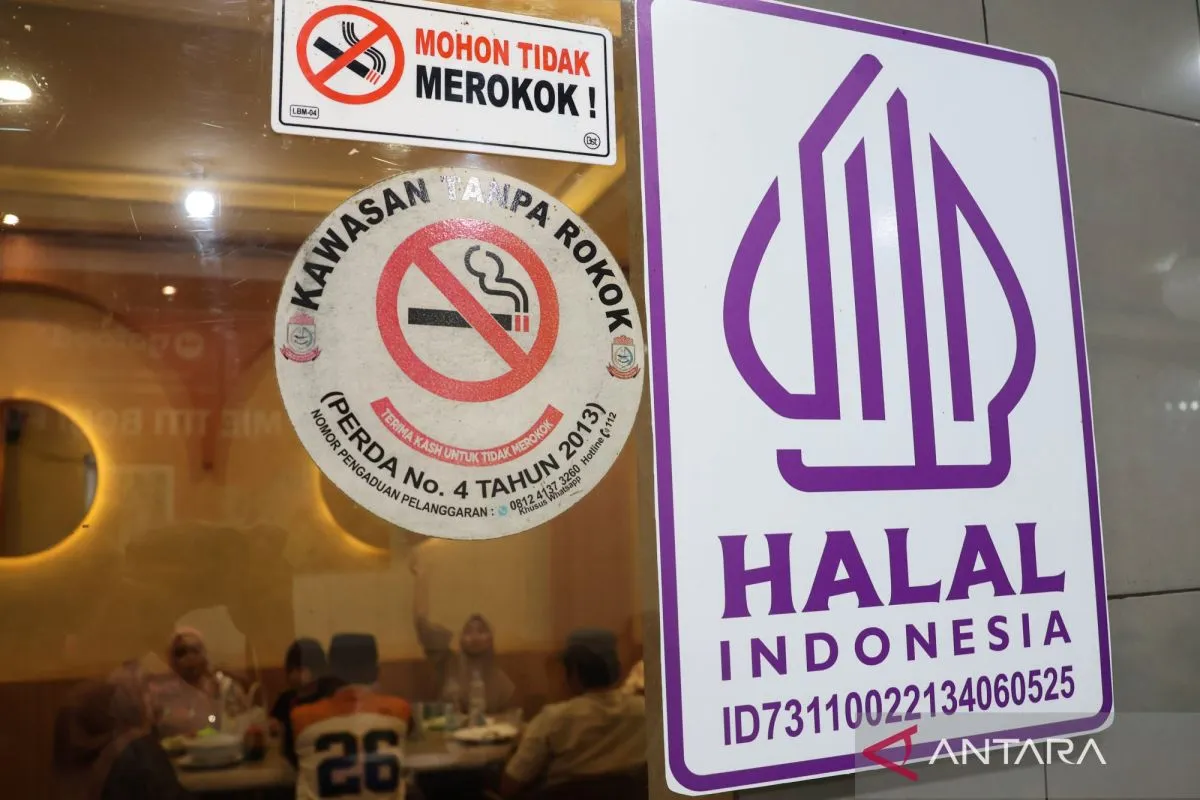
BPJPH head Ahmad Haikal Hasan said on Monday that proper labeling would allow consumers to make informed choices in accordance with their beliefs and needs.
"With clear labeling that distinguishes between halal and non-halal products, the public can make informed decisions," he said in a statement.
He noted that the mandatory halal policy, as stipulated in Law No. 33 of 2014 on Halal Product Assurance, is aimed at providing legal certainty and consumer protection, not restricting the circulation of certain products.
"We need to correct the misconception that the government prohibits non-halal products from being sold, or that it allows them to be marketed without clear labeling," Hasan stated.
He explained that non-halal products may still be produced, distributed, and traded in Indonesia.
Related news: Indonesia's mandatory halal certification to cover food, cosmetics
However, products derived from prohibited (haram) materials must carry clear and legible non-halal labels in accordance with prevailing regulations, he added.
In distribution and sales, non-halal products must also be separated from halal products to prevent mixing or potential cross-contamination.
This requirement forms part of the traceability principle in the Halal Product Process (PPH), which underpins the halal product assurance system.
Hasan said the halal product assurance policy is neither discriminatory nor intended to limit businesses.
"Instead, it is designed to create a transparent and fair business ecosystem that provides certainty for all industry players, including halal and non-halal producers," he remarked.
The halal certification is mandated under the 2014 Halal Product Assurance Law and reinforced by Government Regulation No. 42 of 2024 on the implementation of halal product assurance.
Under the current regulations, Indonesia mandates that all consumable goods, including food, beverages, medicines, and cosmetics, must obtain halal certification by October 2026.
Related news: Indonesia pushes Muslim-friendly tourism to boost Islamic economy
Related news: Indonesia pushes halal industry as D-8 Chair for 2026–2027
Translator: Arnidhya Nur, Raka Adji
Editor: Anton Santoso
Copyright © ANTARA 2026


