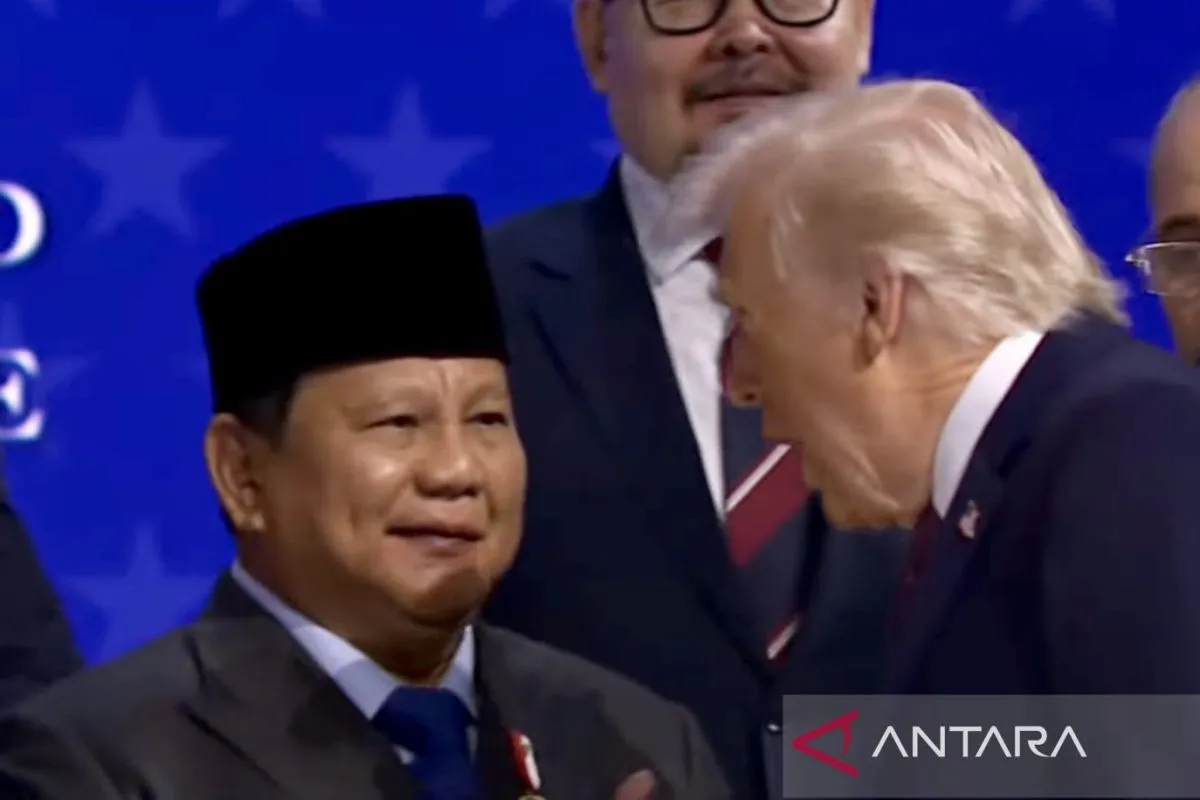
Despite widespread concerns about the Board, Indonesian Foreign Minister Sugiono stated that Indonesia's participation in the Board represents a strategic, constructive, and concrete step to oversee post-conflict stabilization and rehabilitation in Gaza.
"This Board of Peace is a concrete alternative that we can currently hope to achieve," Sugiono said.
He explained that the Board would function as a transitional administrative body in Gaza, as originally endorsed by the UN Security Council in November 2025.
It will coordinate reconstruction efforts in Gaza, which will be carried out in stages.
In a sign of progress on unresolved elements of the first phase of the truce, Sugiono revealed that Gaza's main gateway, the Rafah border crossing with Egypt, would soon be reopened for humanitarian aid.
The Board of Peace will also work toward deploying the International Stabilization Force (ISF), a peacekeeping mission made up of international armed personnel and tasked with training a new Palestinian police force.
"Our participation means that the world recognizes Indonesia's diplomacy, as well as Indonesia's vision and views for world peace and, in particular, the region's peace," Sugiono stated.
Before deciding to join, he said Indonesia had considered various aspects, especially its consistency in supporting international peace and stability, particularly for the Palestinian people.
He described the move as the culmination of a long series of dialogues and meetings among a number of countries, particularly Islamic nations and Muslim-majority states, concerning the situation in Palestine.
He said he hoped the participation of these countries would ensure that all actions taken remain oriented toward Palestinian independence and the realization of a two-state solution.
Concluding his remarks, Sugiono emphasized that the Board is not intended to replace the role of the United Nations (UN), which has long worked to maintain international peace and security.
"This body is not meant to replace the UN. It is an international body born out of concern for creating peace and stability, particularly in Gaza. For that reason, Indonesia has decided to take part," he said.
Indonesia's participation in the Board of Peace is seen as an effort to "open up space for influence from within."
In an increasingly transactional and power-oriented international political landscape, any forum that offers direct access to decision-making centers is worth utilizing, provided it does not sacrifice core foreign policy principles, said Ahmad Khoirul Umam, Director of the Paramadina Graduate School of Diplomacy at Paramadina University.
He expressed the belief that Indonesia's participation in the Board is not meant to legitimize a unilateral agenda and should be viewed pragmatically and strategically rather than ideologically.
This step is considered relevant because the Palestinian issue has been experiencing a structural impasse: various UN resolutions have not been implemented, multilateral mechanisms have weakened, and major powers have become part of the problem.
"By being on the Board of Peace, Indonesia has an opportunity, albeit limited, to inject a Global South perspective, emphasize the humanitarian dimension, and insist that the Palestinian issue not be reduced to merely a matter of Israeli security," he said.
However, Umam cautioned that this position will only be effective if Indonesia takes an active and substantive stance. Indonesia must consistently uphold the international legal framework, the right to self-determination, the end of occupation, and the protection of civilians.
Furthermore, it is necessary for Indonesia to build a coalition of middle powers within and around the Board so pressure on the Palestinian peace process does not become isolated, he emphasized.
"Indonesia must push for concrete, measurable steps, such as a sustainable ceasefire, unconditional humanitarian access, and accountability mechanisms, rather than simply repeating the fruitless narrative of a 'peace process,'" he added.
He further stated that Indonesia's move to join the Board of Peace is relatively consistent with the framework of an independent and active foreign policy.
According to him, the principle of a "free and active" foreign policy does not mean avoiding forums that are not ideal, but rather actively defending principles while maintaining distance from bloc ties and the narrow agendas of major powers.
"Indonesia is not tying itself to Trump's political designs, but is utilizing the available space to fight for humanitarian interests and international justice," he said.
Umam added that Indonesia must emphasize that participation in the Board of Peace must not obscure its firm stance against the occupation, violations of humanitarian law, and the structural inequalities that are at the root of the Palestinian conflict.
As long as these principles are upheld, according to him, Indonesia's participation will strengthen its identity as a moral and strategic middle power.
"If managed carefully, this step can broaden the channels for the Palestinian struggle amid weakening multilateralism, while also affirming that Indonesia's independent and active foreign policy remains relevant in an increasingly violent and less-than-ideal world," Umam concluded.
Related news: Indonesia backs Palestine statehood via Gaza peace board
Editor: Anton Santoso
Copyright © ANTARA 2026


