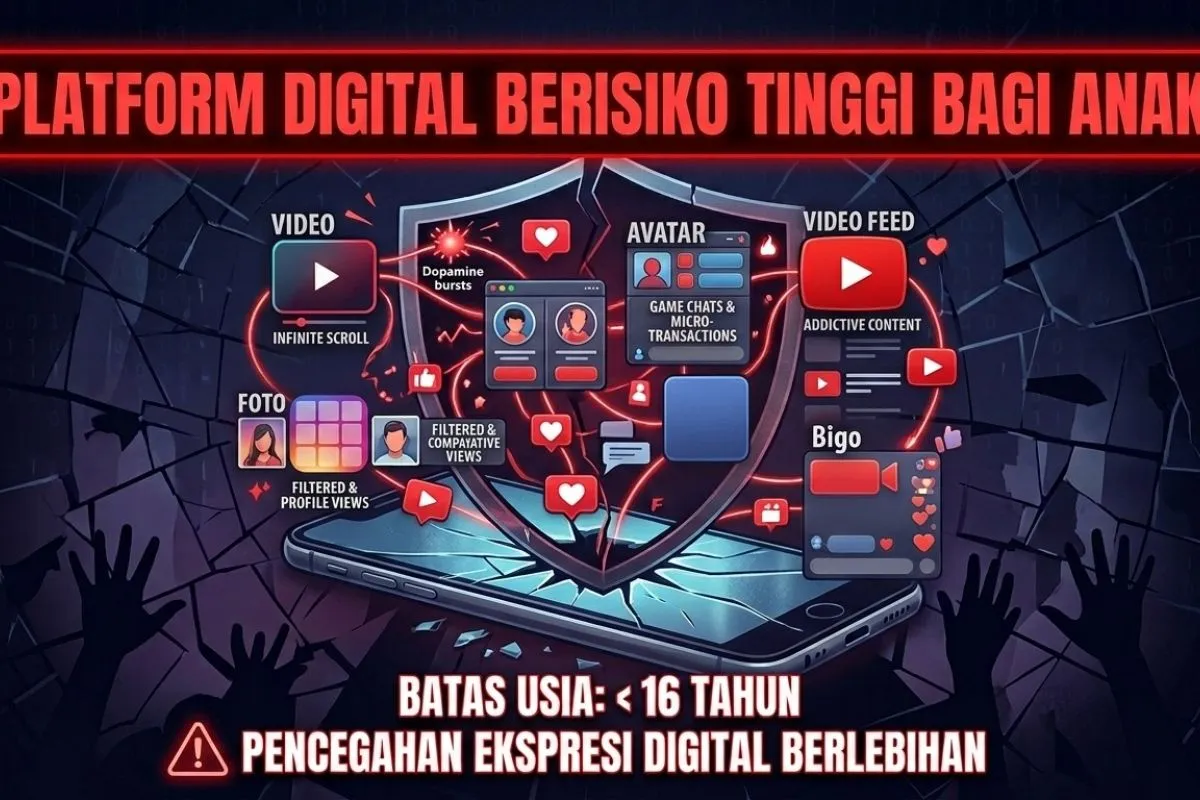
Indonesia's policy to restrict children's access to social media emerged amid the rise of cases involving children in digital spaces.Surabaya, East Java (ANTARA) - The Indonesian government has officially issued the Communication and Digital Affairs Minister's Regulation Number 9 of 2026, which restricts social media access for children under 16 on high-risk digital platforms.
The regulation serves as the implementing rule for Government Regulation No. 17 of 2025 on Electronic System Governance for Child Protection, locally known as PP TUNAS.
Through this policy, the government provides specific instructions for digital platform providers to protect Indonesian children online.
In this context, digital platforms are defined as internet-based systems that facilitate online interaction, transactions, and content distribution.
The regulation, set to take effect on March 28, 2026, mandates the phased deactivation of accounts belonging to children under 16 on high-risk digital platforms, including YouTube, TikTok, Facebook, Instagram, Roblox and Bigo Live.
The platforms are categorized as high risk not solely based on the type of content circulated, but also on the digital architecture of platforms which is designed to maximize user engagement.
Platforms such as TikTok, Instagram, and Roblox utilize powerful behavioral psychology to increase watch and play time. For children who have not yet reached cognitive maturity, these mechanisms can potentially lead to negative impacts, ranging from digital addiction to psychological disorders.
Indonesia is not the first country to take that step. Australia pioneered the move by banning access to social media for children aged under 16 years with a regulation enacted on December 10, 2025.
The ban covers platforms such as TikTok, Instagram, X, Facebook, and Snapchat. Under this policy, parental consent cannot be used as an exemption. Platforms that violate these rules may face fines of up to 50 million Australian dollars.
Meanwhile, Denmark reached a political agreement in November 2025 to restrict social media use for children under the age of 15, with the goal of passing it into law by mid-2026. The country is even utilizing its national digital identity verification system to ensure the accuracy of users' ages on the platforms.
Related news: Indonesia restricts under-16 access to high-risk digital platforms
Surge in cases
Indonesia's policy to restrict children's access to social media emerged amid the rise of cases involving children in digital spaces.
UNICEF data shows that approximately 50 percent of Indonesian children using the internet have been exposed to sexual content on social media, while 42 percent admit to feeling afraid or uncomfortable due to their digital experiences.
A report by the Ministry of Communication and Digital Affairs, in collaboration with the National Center for Missing and Exploited Children (NCMEC), also highlights the alarmingly high rates of online child sexual exploitation in Indonesia.
Indonesia currently ranks third globally, with approximately 1.45 million recorded cases of online child sexual exploitation.
One common tactic used by predators is utilizing fake accounts to groom children into sending explicit content—a practice known as sextortion.
A case in Situbondo in December 2025 serves as a grim example, where a 14-year-old teenager became a victim of sexual assault after being groomed through social media communications.
Additionally, cyberbullying has also triggered various tragedies. The Indonesian Child Protection Commission (KPAI) recorded that in the period of 2023–2025, Indonesia's child suicide cases were the highest among Southeast Asian countries.
In October 2025, a series of child suicide occurred in Cianjur and Sukabumi, triggered by psychological pressure due to cyberbullying.
KPAI data shows that the majority of victims fall within the 13–15 age bracket—the very demographic most affected by current social media age-restriction policies.
Furthermore, social media has even been exploited as a tool for other serious crimes, including human trafficking.
The kidnapping of a toddler named Bilqis in Makassar in November 2025 uncovered a child-selling scheme operating through Facebook groups under the guise of adoption, with prices ranging from Rp3 million (approximately US$177) to Rp80 million.
The case revealed a cross-provincial human trafficking network operating through digital platforms.
Related news: Indonesia flags rising global threat of online romance scams
Challenges
Based on Statistics Indonesia (BPS) data and the 2025 digital literacy survey, approximately 39.7 percent of early childhood children in Indonesia already use mobile devices, while internet penetration among Generation Z has reached 87 percent.
In underdeveloped, remote, and outermost regions, children aged 13–14 reportedly show even higher levels of social media addiction due to limited real-world entertainment options. The effectiveness of this new ministerial regulation relies heavily on the "triangle of oversight".
The three main components are the government's firmness enforcing regulations, digital platforms' compliance, and parents' ability to understand and supervise children's digital activities. If one of the three does not run optimally, children could potentially use a loophole to access risky digital space.
In terms of regulation, the government has already established a clear sanctions mechanism under the Government Regulation Number 17 of 2025.
These sanctions range from written warnings and administrative fines to the temporary suspension of services and the blocking of access for electronic system providers that fail to comply with the rules.
However, implementing this policy requires an educational approach by improving digital literacy within both the education system and the family environment.
Related news: Indonesian VP urges teachers, parents to boost AI literacy
Digital ecosystem and children
Children aged under 16 years—typically in kindergarten, elementary school, and junior high school—are in a critical phase of psychological development.
Those aged 13–15 are both the most active social media users and the most vulnerable to the negative impacts of digital spaces. At this age, peer pressure to remain active on social media is extremely high.
Within the current digital ecosystem for Indonesian children, various platforms serve different roles.
TikTok has become the primary entertainment platform, offering diverse content ranging from dance challenges to comedy, even online shopping.
On Instagram, this age group utilizes the platform to document their daily lives while keeping up with their peers through the Stories feature.
YouTube and YouTube Shorts are widely used for gaming content, tutorials, and unboxing videos.
Meanwhile, Roblox has grown into a game-based social space where children interact and build digital identities through their avatars.
WhatsApp often serves as the primary communication hub for school class groups, friendship circles, and coordinating school assignments.
Because it functions more fundamentally as a communication tool, the platform is typically not included in total bans, though specific features still require supervision.
Among more tech-savvy teenagers, Telegram and Discord are also gaining their popularity for finding online communities, such as those centered on gaming, anime, and pop culture.
Related news: Collaboration necessary to eradicate cybercrime: legislator
Family digital literacy
Ultimately, delaying social media access for children is not simply about restricting technology. It can be viewed as an emergency measure aimed at protecting children in an increasingly complex digital ecosystem.
However, it must also be accompanied by efforts to ensure that younger generations can continue to express themselves and nurture creativity in the digital world.
The role of parents is crucial in this process. Family digital literacy must be strengthened so that parents can better understand how digital platforms operate while guiding their children toward safe and healthy digital behavior.
Without active family involvement, even the strictest regulations risk losing effectiveness amid the rapid evolution of digital technology.
Related news: Minister Hafid explains social media age limit policy to students
Editor: M Razi Rahman
Copyright © ANTARA 2026


