There is a fundamental question that often goes overlooked when discussing downstreaming: for whom is that added value actually being created?
When various large-scale industrial projects are set in motion, success is often measured solely by production capacity, investment value, or export figures. However, the most honest metric lies in the extent to which these changes impact people's lives.
This is what makes the development of an integrated copper and gold downstreaming ecosystem - such as in the Java Integrated Industrial and Ports Estate (JIIPE) Special Economic Zone in Gresik -interesting for further discussion.
This requires viewing it not merely as an industrial project, but as an economic laboratory - one that tests whether growth can truly go hand in hand with equity.
The project - whose groundbreaking was spearheaded by Danantara, the nation's sovereign wealth fund - features synergy of various state-owned enterprises, including MIND ID, DEFEND ID, ANTAM, Freeport Indonesia, PINDAD, and PELINDO.
This collaboration not only reflects the consolidated strength of national industries but also the shift in development approach that is increasingly more integrated from upstream to downstream.
The project includes the construction of a brass mill and a brass cup production facility with an annual capacity of 10,000 tons, alongside a precious metal refinery with a production capacity of 30 tons per year.
With a projected workforce need of up to 7,500 people, the initiative provides opportunities for social mobility, particularly for communities around Gresik District and East Java Province as a whole.
East Java Deputy Governor Emil Elestianto Dardak emphasized that the success of industrial investment depends heavily on its tangible impact on the people, specifically regarding job creation and social stability.
He underscored that downstreaming must not stop at industrialization; it must evolve into a social process that strengthens cohesion and prosperity.
Downstream products
The downstreaming in Gresik has moved into advanced downstream products, making the workforce requirements more diverse and demanding higher levels of competence.
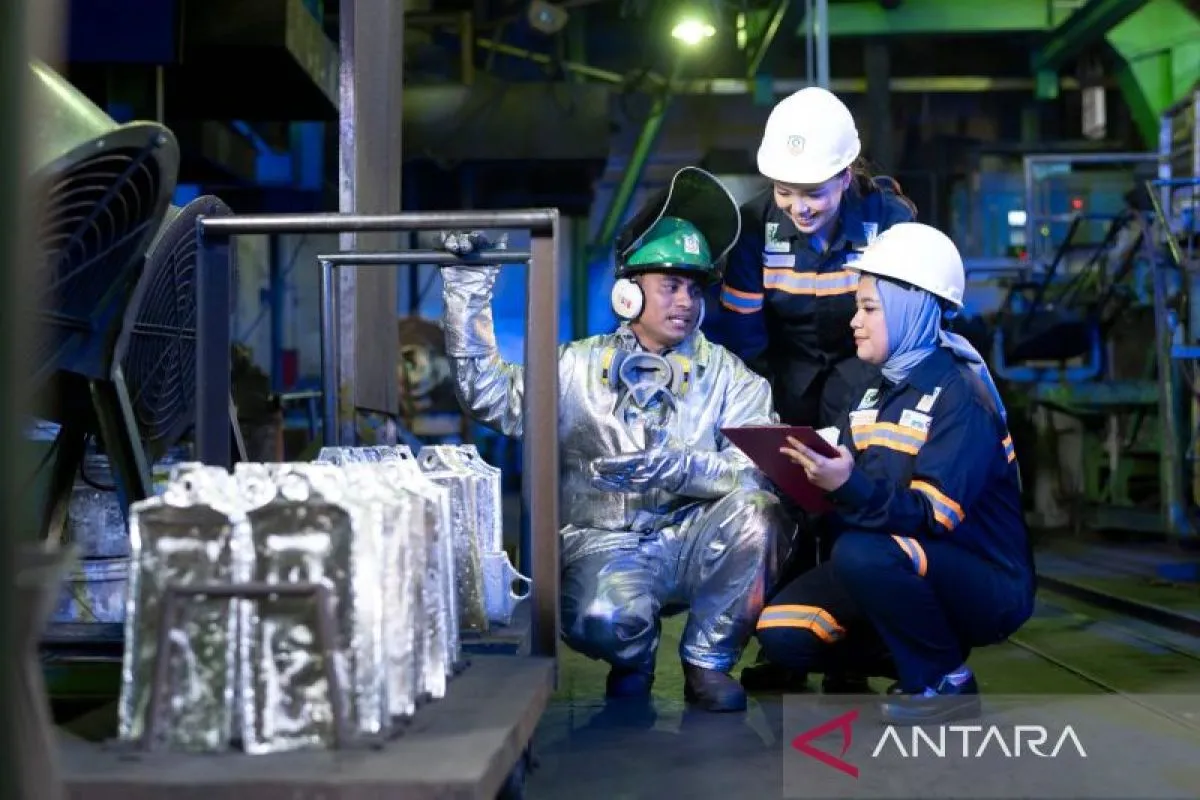
From processing copper cathodes into pipes and wires, to developing raw materials for ammunition under DEFEND ID, and gold refining by ANTAM, the entire production chain is opening up a broad spectrum of employment.
This means the project is not only creating jobs in massive numbers but is also driving an improvement in the quality of the workforce itself.
When an industrial project can shift the workforce from low-wage labor to high-value-added roles, the impact is more than just a short-term boost.
This effort serves as a foundation for more sustainable economic development.
Dardak noted that job creation has the potential to enhance the quality of the local workforce, paving the way for more inclusive economic development.
This inclusivity is vital; without it, growth becomes nothing more than a figure devoid of social meaning.
However, successful implementation requires a policy design that ensures the local labor force is prioritized.
Affirmative action for the local community, as stated by the deputy governor, is key to ensuring that downstreaming truly benefits the region.
When the local residents are involved as part of the value chain, social stability will be maintained, and investment will have a stronger foundation.
Furthermore, this project demonstrates how downstreaming can serve as an instrument for economic equity. East Java - particularly the Gerbangkertosusila metropolitan area - has long made significant contributions to the national economy.
With the presence of integrated downstream industries, this contribution is poised to grow while simultaneously spilling over into other sectors. The multiplier effect will not only impact the industrial zone but also the service, trade, and small business sectors in the surrounding areas.
Division of roles
The downstreaming concept in Gresik also reflects a more balanced division of roles between regions.
While upstream producing regions continue to benefit from extraction activities, regions like East Java focus on multi-commodity, advanced-stage downstreaming.
This approach is essential to avoid inequality in development between regions and ensure each region has a strategic role in the national value chain.
On a global scale, this move strengthens Indonesia’s position as a nation that no longer simply exports raw materials but instead provides high-value-added products.
Global competitiveness must be built not only through industrial capacity but also through high-quality human resources, social stability, and good governance. Without these pillars, downstreaming risks becoming a large-scale project that loses its local significance.
In this regard, the presence of this project should be accompanied by investment in education and vocational training. The demand for skilled labor in the downstream sector requires synergy between industry, the government, and educational institutions.
If this synergy runs effectively, downstreaming will not only create jobs but also foster a more competitive generation of workers for the future.
Ultimately, downstreaming is more than just an economic strategy; it is a choice regarding the direction of national development - whether this nation will move towards rapid but unequal growth, or growth that is perhaps more complex, yet far more equitable.
The project in Gresik demonstrates that the two are not necessarily mutually exclusive. Through cross-sector collaboration, affirmative action for the local community, and a focus on upgrading the workforce, downstreaming can serve as a bridge between growth and equity.
The greatest hope for this project lies not in production and investment figures, but in the stories of those who gain new opportunities.
When workers improve their livelihoods, when families feel the impact of better jobs, and when the region grows without losing its social identity - that is when downstreaming truly fulfills its ultimate goal: to enhance the welfare of the community.
Related news: Second phase-downstreaming to strengthen energy security: Danantara
Related news: Foreign investors remain committed to investing in Indonesia: minister
Editor: Primayanti
Copyright © ANTARA 2026


