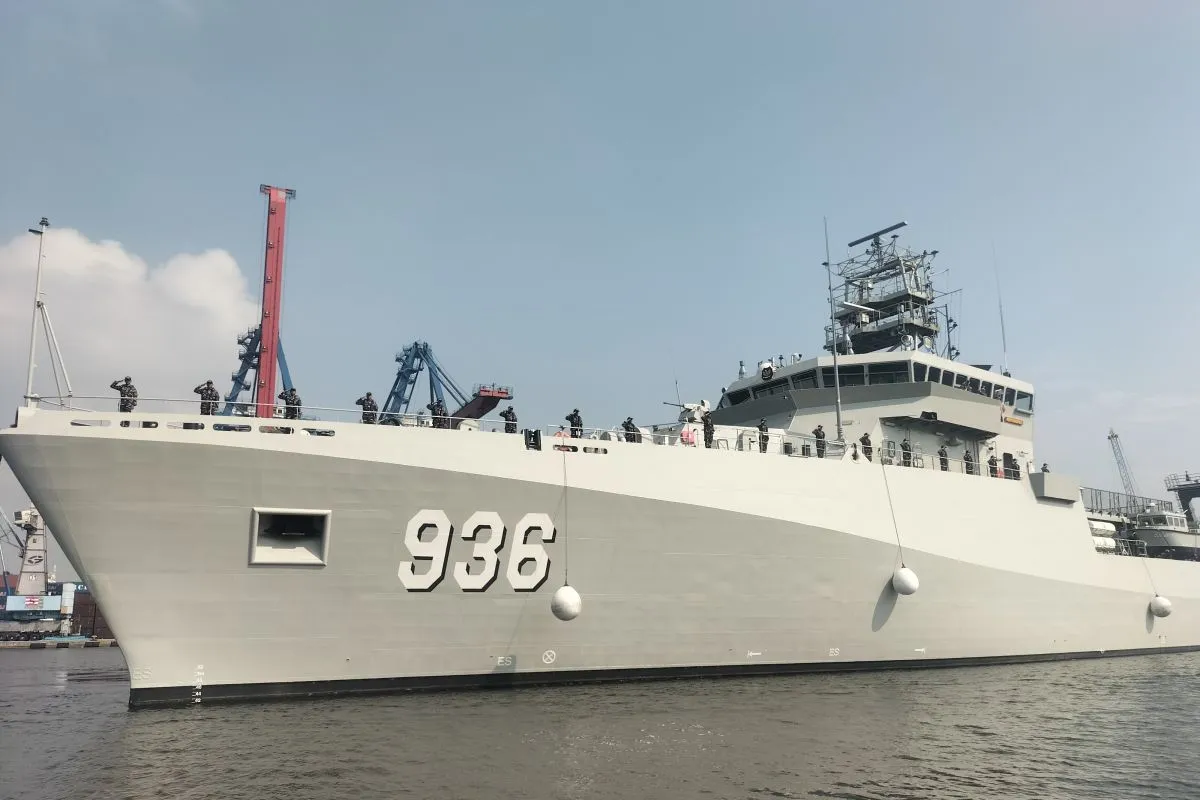
Navy Chief Admiral Muhammad Ali said the training was designed to strengthen personnel expertise in navigation, hydrography and maritime mapping as Indonesia expands its naval surveying and underwater capabilities.
"They underwent training in Germany and previously also studied in France and several other countries, including Indonesia, as we already have a hydrography school," Ali told reporters in Jakarta.
Ali said all 93 crew members received both classroom instruction and practical operational training during their programs in Europe.
While in Germany, the sailors were introduced to the operation of the KRI Canopus-936, including onboard systems, navigation equipment and other technical functions.
The training was conducted in Germany because the vessel was built through a collaboration between German shipbuilder Abeking & Rasmussen and Indonesian company PT Palindo Marine.
Ali said the lengthy preparation ensured navy personnel were fully ready to operate the vessel during its voyage from Germany to Indonesia.
The Indonesian crew successfully sailed the vessel across several oceans to Jakarta in a 57-day journey, he added.
The KRI Canopus-936 has now arrived in Indonesia and is ready to operate under the Navy's Hydro-Oceanographic Center, known as Pushidrosal.
Ali said the addition of the vessel would strengthen Indonesia's maritime defense and improve the navy's ability to safeguard the country's territorial waters.
The vessel is equipped with advanced technologies, including a Hydrographic Survey Launcher, Autonomous Underwater Vehicle, Remotely Operated Vehicle, Autonomous Surface Vehicle, and Unmanned Aerial Vehicle.
"The equipment is used for hydrographic, oceanographic and geophysical surveys, including detailed seabed mapping," Ali said.
Beyond underwater monitoring, the vessel can support military operations such as submarine route mapping, mine detection, maritime security patrols and intelligence missions.
Ali said the ship is also capable of conducting underwater search-and-rescue operations, including detecting emergency signals and locating objects on the seabed.
He added the technology would improve the navy's ability to search for submarines involved in accidents or sinking incidents at sea.
Related news: Indonesia's navy prepares bases for Garibaldi carrier
Related news: Indonesian Navy welcomes nation's first submarine rescue vessel
Translator: Walda M, Rahmad Nasution
Editor: Anton Santoso
Copyright © ANTARA 2026


