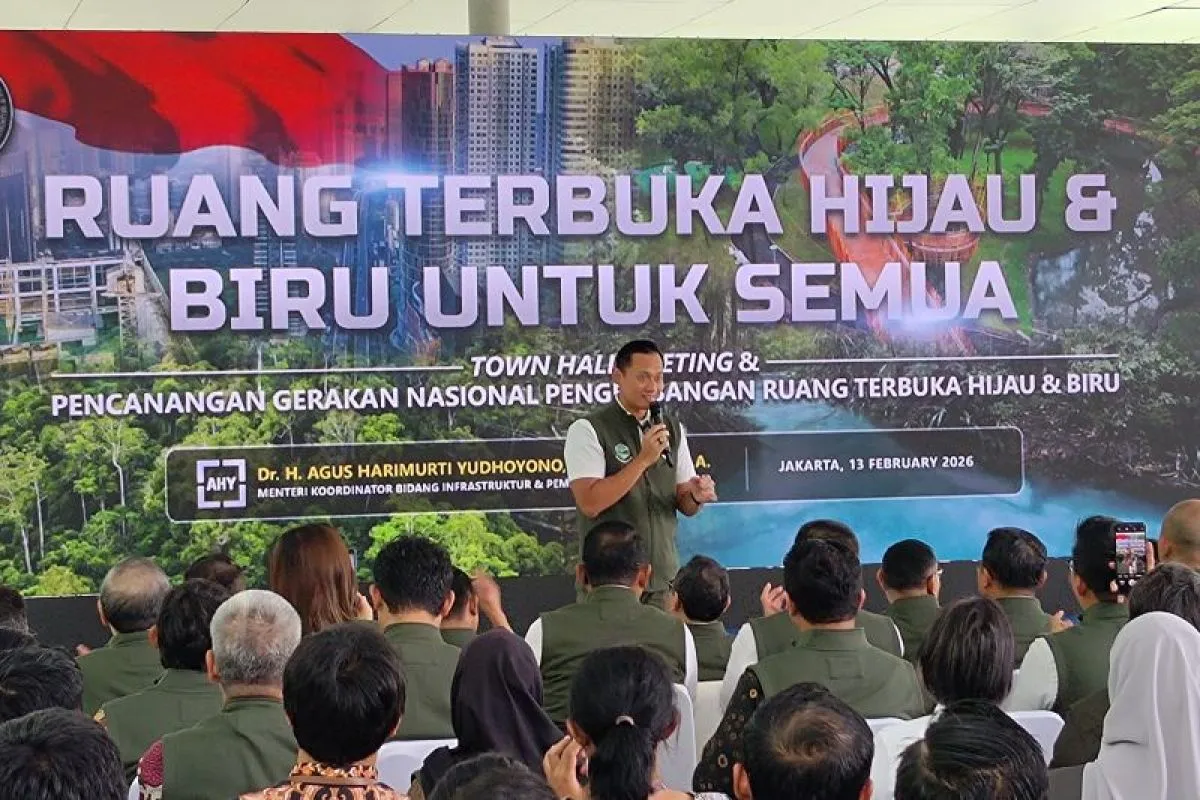
"This is a comprehensive movement across all regions from Aceh to Papua," he said after launching the National Movement for the Development of Green and Blue Open Spaces at Tebet Eco Park here on Friday.
He emphasized that the national movement targets not only cities but also districts. However, the main focus is directed at urban areas amid the continuing urbanization trend.
According to him, both globally and nationally, around 70 percent of the population is projected to live and carry out activities in urban areas, making it important to prepare cities with adequate carrying capacity.
"Therefore, we are focusing on our cities and preparing their carrying capacity to ensure comfortable living conditions for all," he remarked.
He noted that Indonesia has a high level of disaster risk, particularly hydrometeorological disasters, and strengthening green open spaces is expected to be part of the mitigation solution.
"We know that disaster risks in Indonesia are very high. Therefore, green spaces are expected to serve as areas that can help address or mitigate natural disasters," he said.
He cited extreme rainfall with excessive water discharge as an example, noting that green and blue open spaces can function as water absorption and retention areas to reduce the risk of flooding in urban areas.
In addition to flood mitigation, Yudhoyono said that vegetation in green open spaces also contributes to reducing air pollution through carbon absorption by trees.
He stressed that meeting this target is important to ensure that communities have healthy, productive, and creative living spaces, while maintaining environmental sustainability amid ongoing carbon emissions.
Related news: Jakarta expands green open spaces with ecological, social functions
Related news: Jakarta turns empty toll spaces into child-friendly green zones
Related news: Green open spaces in Jakarta produce hundreds of kilos of chilies
Translator: Aria, Kenzu
Editor: Azis Kurmala
Copyright © ANTARA 2026


