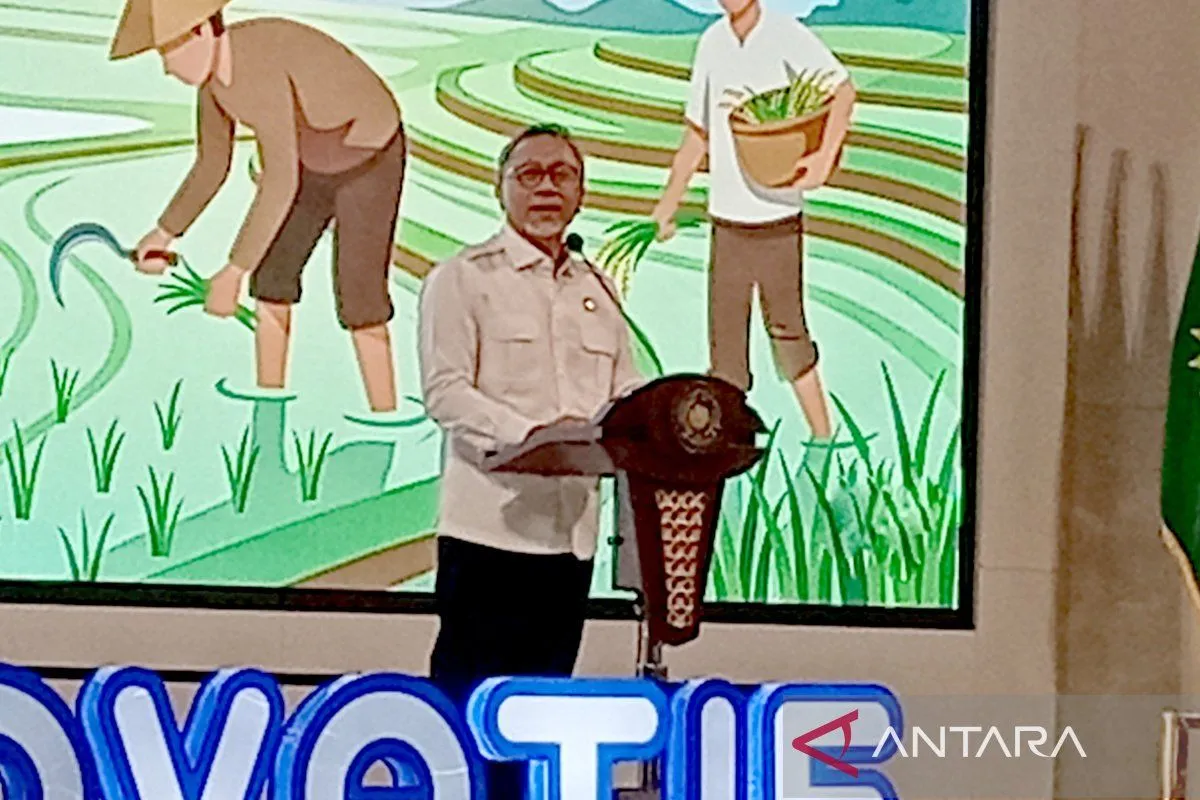
"Despite the global situation affecting almost all countries, Indonesia’s food supply remains secure. We have 4.7 million tons of rice," he said on Saturday.
"This year’s production, God willing, will be higher than last year. There are sufficient supplies of fish, eggs, and chicken, as well as plenty of vegetables and fruit," he added.
Hasan delivered the remarks while speaking at the auditorium of Muhammadiyah University of Purwokerto (UMP) in Banyumas District, Central Java, where he served as keynote speaker at a national seminar on "Strengthening Food Security in Indonesia and the Role of Muhammadiyah in Building a Sustainable Food Availability Ecosystem."
He said the adequate availability of food indicates that Indonesia’s food security remains intact, even as several countries face pressure from conflicts and disruptions to global supply chains.
According to him, strengthening food security going forward will depend not only on availability, but also on sustainable production driven by innovation and research.
He emphasized the importance of collaboration with universities to develop superior crop varieties and agricultural technologies, including research on rice, coconut, cocoa, corn, and other plantation commodities.
"To maintain sustainable food security, we need research, new rice varieties, and superior seeds for coconut, cocoa, corn, and others. We must collaborate with all universities," he said.
Hasan also encouraged the development of simple technologies to process organic waste into fertilizer in order to support agricultural productivity.
In addition, the government plans to build modern rice milling facilities in several regions, including Banyumas, in cooperation with Perum Bulog as part of efforts to strengthen downstream agricultural industries.
"God willing, Banyumas will receive one rice milling facility to be built with Bulog, as this area, including Banyumas, Cilacap, Purbalingga, and Banjarnegara, is a major rice production center," he said.
Banyumas Regent Sadewo Tri Lastiono expressed the regional government’s readiness to support the initiative by preparing strategic land.
"I was asked to provide between two and five hectares of land for the construction of a modern rice mill, and we have prepared several alternatives," he said.
He noted that the land provision reflects local support for central government programs, particularly in developing post-harvest processing facilities to increase the added value of agricultural products.
Meanwhile, UMP' Rector Jebul Suroso said the university is ready to strengthen food research and downstreaming through collaboration with the government.
"I spoke about post-harvest rice processing, and it turns out the Banyumas district welcomed the plan for a modern rice mill to be built in cooperation with Bulog," he said.
"I think this is positive and also a challenge for UMP to further strengthen its role in food research and downstreaming," he added.
He stressed that the university is also committed to supporting millennial farmers in contributing to national food security programs.
"UMP will always be ready. We support the emergence of millennial farmers so they can contribute to food security and government programs," he said.
In addition, the university supports the Free Nutritious Meals program by providing kitchen facilities on campus.
"We also support the program. At UMP, we have established at least three kitchens for the initiative," he added.
Related news: Sustainable agriculture to achieve food security: deputy minister
Related news: Govt pushes research–industry integration for economic growth
Translator: Sumarwoto, Katriana
Editor: Primayanti
Copyright © ANTARA 2026


