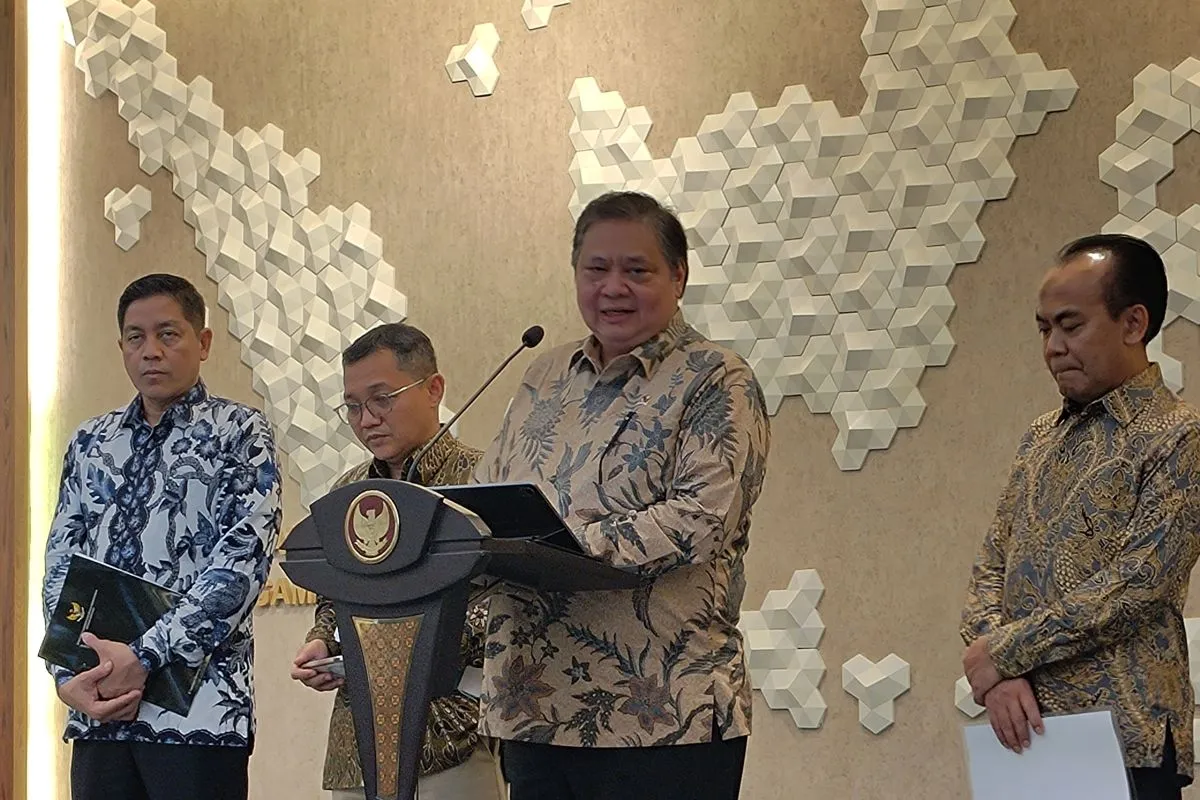
Coordinating Minister for Economic Affairs Airlangga Hartarto said the government continues to monitor fuel prices closely as international crude markets remain volatile, speaking at a press briefing in Jakarta on Tuesday.
He said global oil prices are currently moving within a range of US$90 to US$120 per barrel, reflecting ongoing uncertainty driven by external economic and political developments.
Prices have recently hovered within that band before easing back toward around US$100 per barrel, underscoring the fluid nature of global energy markets, he added.
Airlangga attributed the volatility to multiple factors, including geopolitical tensions that continue to cloud supply expectations and complicate price forecasting.
He stressed the government is not relying on a single fixed scenario, opting instead for flexible policy responses that can adapt to evolving market conditions.
“What matters is that we have scenarios in place, and they are dynamic,” Airlangga said, emphasizing preparedness over rigid planning.
Such flexibility allows authorities to respond quickly and in a measured way to abrupt changes in global energy prices, he added.
The government is also tracking realized energy procurement costs, which do not always match peak global prices because purchases are based on average pricing mechanisms.
That approach helps limit the burden of energy subsidies despite sharp swings in international oil benchmarks, according to Airlangga.
On the fiscal side, Indonesia has allocated energy subsidies and compensation in its 2026 state budget to maintain purchasing power and broader economic stability.
Authorities are also accelerating domestic energy development, including biodiesel and renewable energy programs, to reduce reliance on imported fuels.
Airlangga said the planned rollout of B50 biodiesel in July and faster renewable deployment could cut diesel imports by about Rp48 trillion.
Expanding alternative energy sources is seen as critical to strengthening long-term energy security and reducing exposure to global market shocks.
Beyond pricing and supply measures, the government is preparing trade policy adjustments to ensure adequate domestic energy availability.
One step under consideration is reducing import duties on liquefied petroleum gas to zero from five percent to support supply, Airlangga said, adding policies aim to balance prices, supply security and fiscal health.
Related news: Indonesia to maintain coal use amid energy security concerns
Related news: Indonesia plans to roll out incentives for 200,000 electric vehicles
Translator: Aria A, Rahmad Nasution
Editor: Primayanti
Copyright © ANTARA 2026


