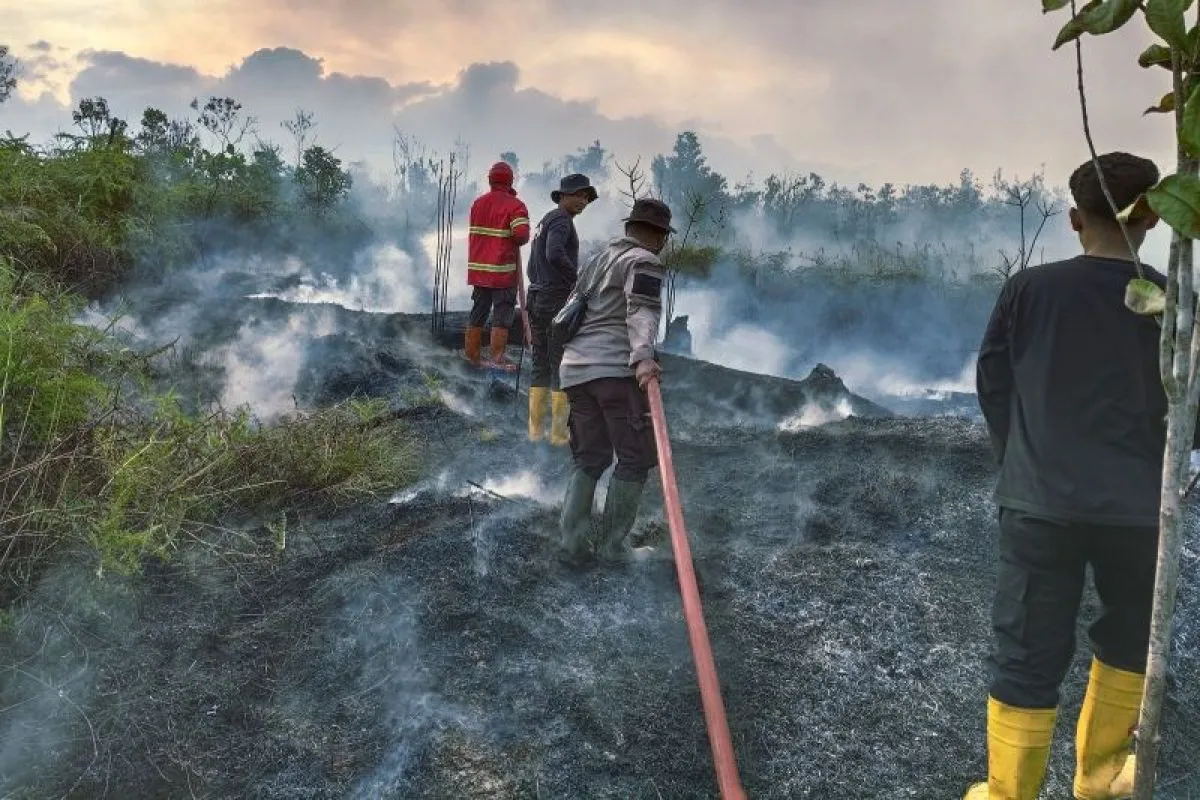
The skies turned a deep red in the final weeks of March and early April over Natuna District, Riau Islands Province, as prolonged dry conditions linked to the El Niño phenomenon triggered widespread wildfires across the region.
What began as thin plumes of smoke gradually thickened into dense haze, blanketing forest areas and dry land after extended rainless days. Vegetation, stripped of moisture, became highly flammable, effectively turning large swathes of land into natural fuel.
Under these conditions, fires ignited easily and spread rapidly, affecting multiple locations in a short span of time.
The largest initial blaze broke out in Bunguran Timur Laut Sub-district on March 23, burning approximately 50 hectares of land. The fire spread quickly, moving from dry bushes to larger trees and intensifying within hours.
That night, a joint team worked for more than three hours to contain the flames. Personnel from the Fire and Rescue Department and the police struggled to control the fire with limited equipment.
Fire trucks could only reach certain accessible areas, forcing officers to continue on foot through thick smoke and intense heat. In many cases, they relied on simple tools such as branches and twigs to beat back the flames, as no other options were available.
“There were no significant obstacles, but the impact was indeed extensive,” said Syawal, head of the Natuna Fire and Rescue Agency.
In the following days, the situation became increasingly challenging. New hotspots emerged across Bunguran Batubi, Bunguran Utara, and Bunguran Barat sub-districts. Strong winds and high temperatures accelerated the spread of the fires, pushing them deeper into forested areas that were far more difficult to access.
The difficult terrain, combined with long travel distances and limited water sources, turned firefighting into both a physical and mental challenge. Firefighters were often required to walk for hours while carrying heavy equipment through dense smoke that severely reduced visibility.
As the fires continued to spread, the affected area expanded to hundreds of hectares. The growing haze began to disrupt daily life, with roads covered in smog and visibility reduced. Air quality deteriorated significantly, posing serious health risks, particularly for children and the elderly.
Faced with an increasingly alarming situation, the Natuna District Government escalated its response. The disaster management status was raised from emergency alert to emergency response, effective from March 26 to April 1. This move allowed for broader coordination and provided a formal basis for requesting assistance from the central government.
The decision proved critical. Fires that had spread deep into forest areas could no longer be controlled solely by local resources. A larger and faster intervention was required to prevent further escalation.
Authorities submitted a request for aerial firefighting support, including water bombing operations and weather modification efforts aimed at inducing rainfall.
The response from the central government was swift. The National Disaster Mitigation Agency (BNPB) deployed helicopters for water bombing operations and aircraft for weather modification.
Turning Point
From the skies above Natuna, helicopters began dropping thousands of liters of water onto hotspots that were previously unreachable. Aerial patrols were conducted to detect fire points and monitor smoke patterns, while satellite-based heat detection systems were used to track the spread of the fires in real time.
Weather modification efforts focused on areas with strong cloud potential, with the primary objective of triggering rainfall during the prolonged dry period.
Even before central government assistance arrived, local authorities had already implemented a series of response measures. A ground command post was established in Bunguran Batubi Sub-district, one of the most severely affected areas, with personnel and equipment deployed on site.
Ground patrols were intensified across affected areas to monitor fire activity and assess smoke conditions. Meanwhile, Raden Sadjad Natuna Air Force Base activated an air command post on March 30. This facility served as the operational hub for coordinating helicopters and aircraft involved in aerial firefighting, as well as a center for coordination meetings among various agencies.
The collaboration between ground and aerial teams gradually began to yield results. Fire intensity decreased in several areas, although the threat was not entirely eliminated. Smoldering embers remained a concern, as they could easily reignite fires if not properly managed.
After the situation was brought relatively under control, the local government downgraded the disaster status from emergency response back to emergency alert on April 2, while maintaining a high level of vigilance.
Throughout the response, public safety remained a top priority. Residents were advised to limit outdoor activities during periods of heavy smoke exposure. Authorities also issued regular updates on air quality conditions, while healthcare facilities were placed on standby to handle potential respiratory cases.
For frontline personnel, however, the situation remained a daily struggle. Firefighters and emergency responders worked under extreme heat, traversing land that was still smoldering, while breathing in heavily polluted air.
There were no cameras documenting their efforts in the remote forest areas, and little public recognition. The only sounds were the crackling of flames and the steady movement of personnel working tirelessly to ensure the fires were fully extinguished.
The incident serves as a stark reminder that climate change is no longer a distant or abstract issue. The El Niño phenomenon has demonstrated how quickly prolonged drought conditions can escalate into large-scale environmental disasters.
The Natuna District Government emphasized that wildfire management must go beyond suppression. Preventive measures are equally critical, including strengthening public awareness to discourage land clearing through burning, particularly during the dry season.
Improving early detection systems and enhancing the capacity of personnel and equipment have also been identified as key priorities moving forward.
Cross-sector coordination has proven essential in addressing the crisis. The response involved collaboration between local governments, the Indonesian military (TNI), the National Police (Polri), the National Search and Rescue Agency (Basarnas), volunteers, and support from the central government. This collective effort played a crucial role in mitigating the impact of the disaster.
Raja Darmika, head of the Natuna Regional Disaster Mitigation Agency, stated that the total area burned in March 2026 reached nearly 340 hectares, marking a significant increase compared to earlier in the year.
Behind these figures lies a deeper story of environmental loss, deteriorating air quality, and a prolonged struggle to restore stability in affected areas.
In Natuna, a remote border region far from the bustle of major cities, the battle against wildfires unfolds quietly. Yet its impact is far-reaching, not only in protecting the environment but also in ensuring that communities can continue to live and breathe in safer conditions.
At the heart of this response are the frontline officers whose resilience and dedication remain largely unseen, yet are vital in preventing further devastation.
Related news: Government turns to FDRS for early forest fire detection
Editor: Primayanti
Copyright © ANTARA 2026


