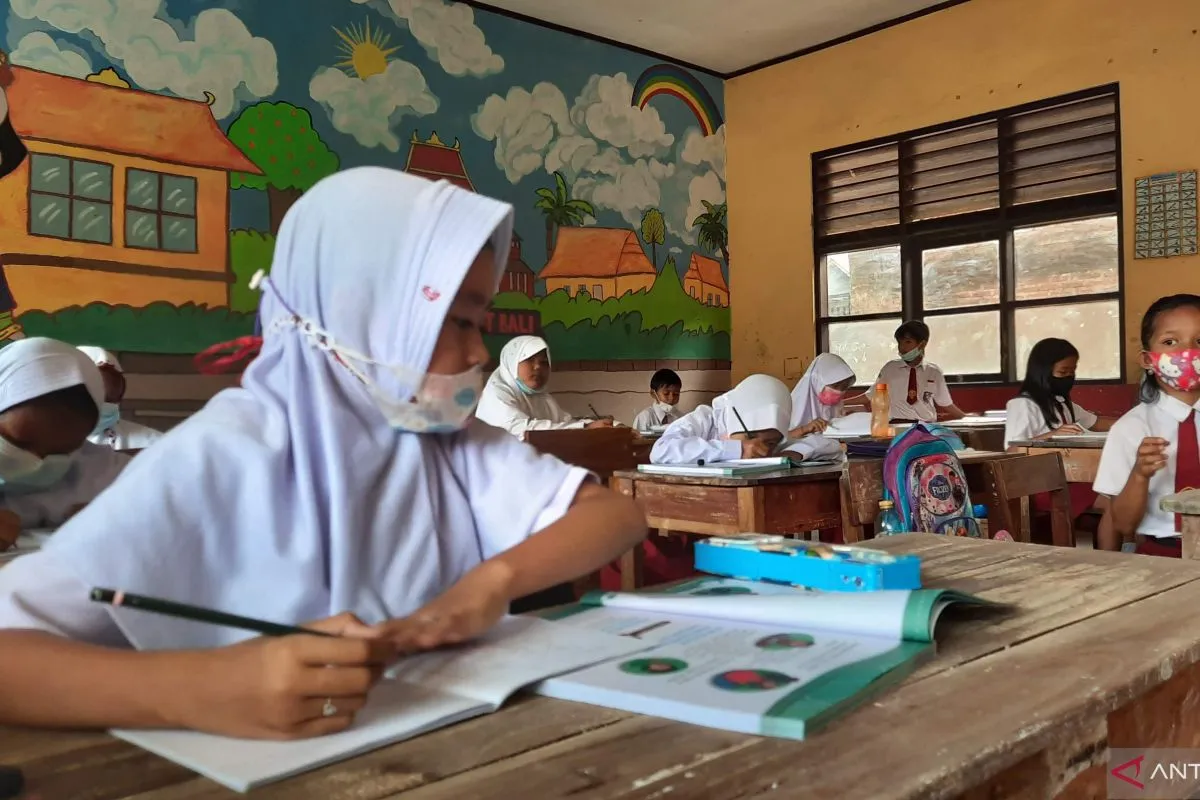
The initiative is now focused on more structured, data-driven interventions, with schools themselves serving as the primary actors.
Dilapidated school buildings—marked by leaking roofs and cracked walls—and classroom shortages remain persistent hurdles to learning, prompting the government to launch the program.
In this context, state interventions have become an urgent necessity to ensure that minimum standards for educational services are met.
For implementing the program, the Ministry of Primary and Secondary Education set three main principles: safety, thorough improvement, and collaboration.
This approach marks a departure from the previous centralized model, moving toward a system based on the actual needs of each school. Data is verified periodically to ensure the program's targets align with real-world conditions.
By the end of 2025, more than 16,000 schools had been revitalized, higher than the initial target. In 2026, the government is scaling up the program to target 71,744 schools with a budget allocation of Rp14 trillion (approximately US$800 million). Initial implementation shows that Rp2.6 trillion has already been disbursed, with thousands of schools moving into the construction phase.
The implementation model has also significantly shifted through a self-management scheme, which provides schools with the authority to independently manage the construction process, from planning to execution.
This mechanism opens up opportunities for the community, including parents and the local workforce, to participate.
According to data from the Presidential Staff Office, the school revitalization program has created 238,131 jobs for the local workforce. On average, each project involves about 22 workers, ranging from construction workers and project supervisors to other support staff.
In practice, this model stimulates the local economy, as materials and project requirements are sourced from vendors near the school sites.
The economic impact is not limited to the construction sector. Approximately 58,000 micro, small, and medium enterprises (MSMEs) are reportedly involved in the program's supply chain.
The presence of workers has boosted demand for daily consumer goods, which in turn increases the income of small-scale traders. This economic activity has also trickled down to the transportation sector and other supporting services.
The self-management approach is deemed able to create efficiency while fostering a greater sense of ownership over the completed projects.
In several cases, schools were able to optimize their budgets to add extra classrooms or repair facilities beyond the original plan. This demonstrates a level of flexibility in resource management that was previously absent under the centralized development model.
The revitalization program is also directed to cover areas with high vulnerability, prioritizing remote, frontier, and outermost areas, disaster-hit regions, and archipelagic areas.
The government has set its focus on schools damaged by disasters as part of its acceleration efforts in 2026, before expanding the program to other schools.
In addition to the physical building aspect, the revitalization program is also integrated with the education digitalization initiative.
Throughout 2025, digital learning tools were distributed to hundreds of thousands of schools. The government also addressed basic infrastructure gaps by providing internet access to over 8,000 previously unconnected schools, including through the use of satellite technology.
Additionally, a partnership was established to bring power to more than 2,300 schools that still lacked access to electricity.
Integrating digitalization
The integration between building revitalization and digitalization demonstrates the government's commitment to realizing more equitable educational services.
Nevertheless, challenges remain regarding the aspect of equitable distribution. The availability of facilities does not automatically translate to improved learning quality without a corresponding shift in teaching practices.
In this context, teachers serve as a determining factor. A shift in mindset regarding the use of new facilities, stronger mentoring, and the reduction of administrative burdens remain key issues of concern.
Without intervention in these areas, the initiative risks stalling at the infrastructure level, failing to yield a significant boost in learning outcomes.
The program also highlights the link between education policy and local economic development.
The self-management scheme creates a multiplier effect that not only improves the quality of educational facilities but also creates jobs and stimulates local economic activity. This is relevant for the economic recovery of several regions still facing limited job opportunities.
Furthermore, the program's expansion in 2026 also demands consistency in supervision and accountability. The large budget and wide coverage require a monitoring system that can ensure the construction quality is consistently maintained.
Data verification, budget transparency, and community engagement are essential elements for maintaining program effectiveness.
Structurally, the revitalization program indicates a shift from a project-based approach toward a systems-based approach.
Schools are no longer positioned as mere beneficiaries; instead, they have become active participants in the construction process. This model allows projects to be tailored to local needs while accelerating implementation.
The school revitalization program is part of a broader strategy to ensure an equitable distribution of quality education nationwide, with physical building intervention, digital infrastructure strengthening, and community engagement forming an interconnected policy framework.
However, ultimately, its long-term success will depend on consistent implementation and the education system's ability to fully utilize the upgraded facilities.
Related news: Indonesia's SMK revitalization program absorbs local workers: Ministry
Related news: Indonesia speeds up rehabilitation of disaster-hit schools in Sumatra
Related news: Central Papua bets on teacher quality for stronger education system
Translator: Aditya Ramadhan, Raka Adji
Editor: Azis Kurmala
Copyright © ANTARA 2026


