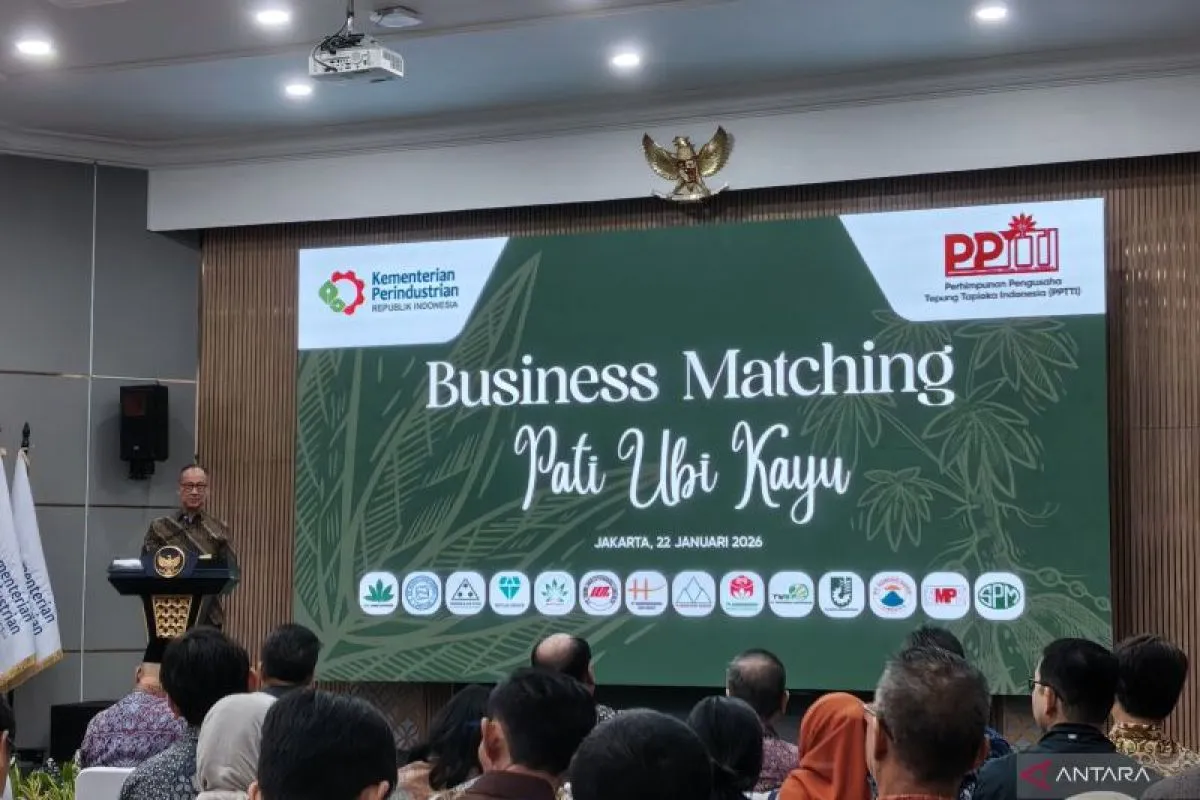
During the opening of the Tapioca Starch Business Matching event in Jakarta on Thursday, Industry Minister Agus Gumiwang Kartasasmita stated that the tapioca starch industry is one of the strategic sectors under his ministry's oversight.
Currently, there are 125 tapioca starch companies in Indonesia. However, data from the National Industrial Information System (SIINas) and Online Single Submission (OSS) show that the industry's utilization rate has reached only 43 percent.
"Tapioca starch is a strategic commodity that has high added value and can be used as a material for various food products, such as sweeteners, seasonings, snacks, and noodles, as well as non-food products, such as paper, chemicals, and ethanol," he remarked.
According to the minister, as of November 2025, Indonesia’s tapioca starch exports reached US$18.7 million, an increase of 58.34 percent year-on-year.
However, Indonesia still imported US$73.8 million worth of tapioca starch during the same period.
Kartasasmita acknowledged that the domestic tapioca starch industry continues to face challenges, particularly in competing on price and quality with imported products.
To address this, the government is encouraging stronger synergy between tapioca starch producers and industrial users, including through the implementation of the Commodity Balance (NK) policy.
He explained that the policy is expected to support the growth of the domestic tapioca starch industry, increase capacity utilization in line with industrial demand, and continuously improve product quality.
Furthermore, Kartasasmita noted that some industrial users still require tapioca starch with specific specifications that have so far only been met through imports.
To overcome this issue, the Ministry of Industry is pushing to strengthen the domestic industry’s capacity to produce tapioca starch that meets these requirements.
He added that Thursday’s business matching event could motivate producers to diversify their products, while assuring industrial users that they can source raw materials domestically.
By strengthening this synergy, the ministry is optimistic that the national tapioca starch industry can achieve more optimal growth, increase capacity utilization, and reduce reliance on imports.
The initiative is also expected to contribute to strengthening the independence and resilience of the national industry.
Related news: Indonesia to limit cassava, tapioca imports to aid farmers
Related news: Shield farmers: Prabowo says amid cassava import glut
Translator: Ahmad Muzdaffar, Raka Adji
Editor: M Razi Rahman
Copyright © ANTARA 2026


