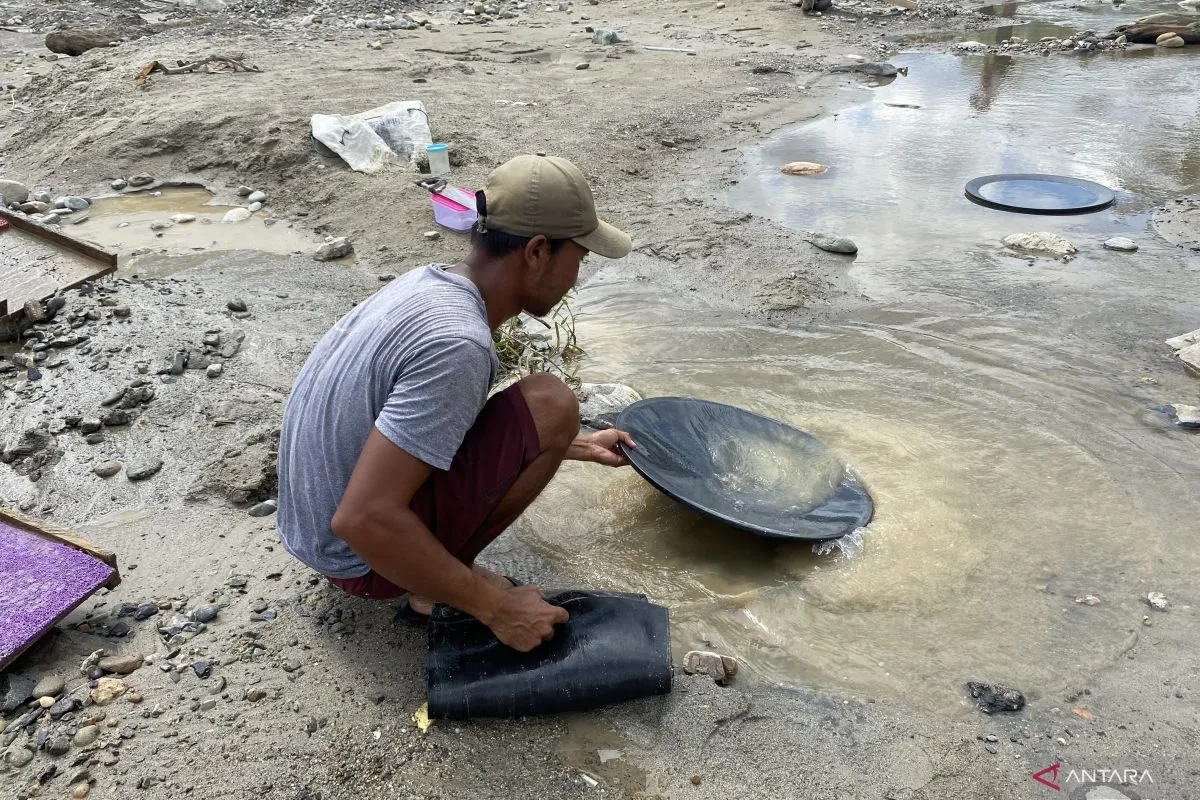
The Alas River in the village has turned into a vital lifeline for the local community in the wake of devastating flash floods and landslides. The powerful currents that tore through in late November 2025 brought more than just rocks and mud; they also brought gold.
Both grief and hope washed over the villagers as they realized the very river that had destroyed homes had now become their temporary source of livelihood.
For the past month, local residents have shifted from farming to gold panning to make a living. It has become a family effort, with children helping their parents while splashing about in the river.
News about the gold spread by word of mouth. Nadia is a newcomer to the work, as is Sawiah, who only joined in late January to try her luck at panning.
“There was never any gold mining here before. No one knows where it came from,” Sawiah said while taking a quick break from her work.
The area of the river where they pan for gold is shallow and calm. The water flows gently, ankle-deep, allowing villagers to sit cross-legged and set up makeshift tents for shade. Underneath, they slowly shake 60-centimeter pans rhythmically.
Panning is the final stage of the process, used to isolate pure gold grains. Before reaching this step, miners scoop up loads of sand from the river and pour them onto a sluice box—a long, inclined trough lined with textured matting or carpet.
The miners then pour water over the sand they have placed onto their handmade equipment. The water and silt wash away, while the gold grains are caught in the carpet.
Just like Nadia and Sawiah, Ibrahim is also new to gold panning. He has been doing this for the past week because his primary source of livelihood before the disaster—construction work and farming—has yet to recover.
“Sometimes I work in construction, sometimes in the farms or the fields. But right now, there’s no work available,” he said.
Practically, these three panners have not yet tried to sell their finds to middlemen. They are still collecting the gold gathered over about a week before selling it to middlemen who visit the village or taking it to the market in the town center themselves.
“I have not experienced (selling it) yet, but others have,” Ibrahim said.
One of those other people is Rukiah. She said she had previously sold the gold she panned at the morning market in Kutacane, the capital of Southeast Aceh District, located about 22 kilometers away.
According to Rukiah, the selling price for gold in the city differs from that offered by middlemen in the village. For this reason, she prefers to sell her finds in Kutacane.
“I got Rp3.1 million (approximately US$184). I sold it at the morning market,” the cocoa farmer said.
After hearing news of gold in the river, Rukiah and her family joined in the gold panning.
"It was not there before. It was only after the floods that wiped out houses that it appeared. This is just a blessing God gives us, isn't it?” she said, still in disbelief.
She decided to join the others in gold panning as her income became unstable after the flooding caused the cocoa trees to stop yielding much fruit. Apart from that, market prices have yet to become competitive again.
Gold panning has helped a lot economically. According to her, the gold buyers are pleased with the quality of the gold panned by the residents of Bener Berpapah. The money from the sales is then used to pay for their children's school fees, electricity, and daily necessities.
Rukiah pans from morning until evening, though she does not always find pay dirt. Because of this, she stockpiles her finds until she has enough to sell.
According to her, the new activity she and other Bener Berpapah residents are doing previously drew a warning from the police over concerns about environmental damage.
Nevertheless, she and the other residents believe that what they are doing is harmless. "Why would we cause damage? We are not taking the soil or the sand away—not at all," she argued.
Indeed, hope often emerges in unpredictable places and at unexpected times. A river that once brought trauma now provides a sense of calm for the residents of Bener Berpapah—offering a source of livelihood after the floods and landslides that reportedly killed over 1,200 people and damaged hundreds of thousands of homes across Sumatra.
However, much like its sudden appearance, the long-term sustainability of the gold is uncertain. Will it be a lasting lifeline for the community or merely a temporary band-aid?
Beneath the luster of the gold, the residents still long for their farms and rice fields to recover—to have secure livelihoods and return to the lives they spent years building.
Related news: Aceh revises 2026 rice target after flood damage
Related news: TNI, locals work to restore access in Aceh after floods
Related news: Indonesian VP inspects flood-hit school in Aceh to speed up recovery
Translator: Fath Putra, Raka Adji
Editor: Azis Kurmala
Copyright © ANTARA 2026


