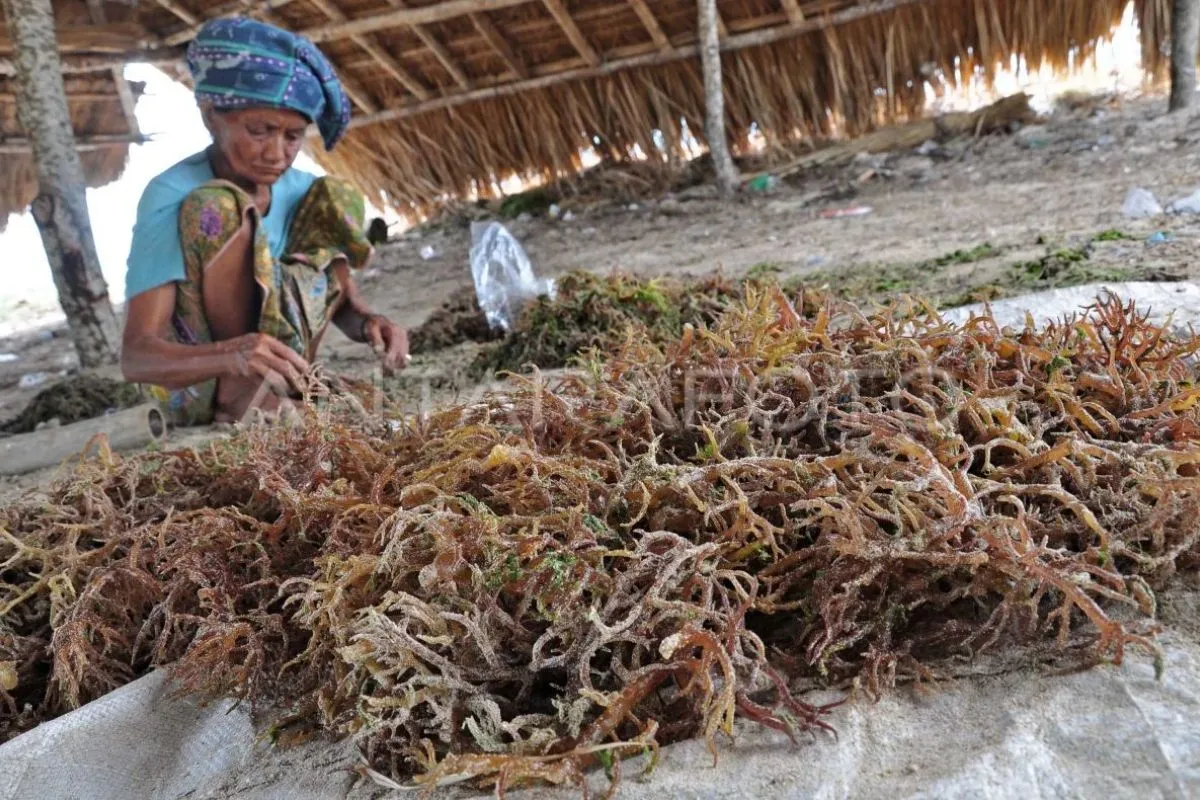
For local residents, the scene is familiar. However, 2026 marks a new chapter as the Indonesian government begins developing an international seaweed research hub, a move expected to strengthen the coastal economy of West Nusa Tenggara and support the global seaweed industry.
Indonesia has broken ground on the International Tropical Seaweed Research Center, designed as a hub for global collaboration. East Lombok District was selected for its long-standing reliance on marine resources.
Deputy Minister of Higher Education, Science, and Technology Stella Christie said Indonesia accounts for around 75 percent of the global tropical seaweed market.
The global economic value of the seaweed industry reaches around US$12 billion annually and continues to grow. Despite this significant figure, Indonesia still largely exports raw materials.
The planned research center is expected to help address this gap. Beyond serving as a laboratory, it aims to support efforts to move up the value chain from raw material producer to developer of value-added products.
Data from Statistics Indonesia (BPS) show that seaweed production in West Nusa Tenggara exceeded 693,000 tons in 2023, valued at approximately Rp1.65 trillion, and increased to 704,810 tons in 2024.
Nationally, West Nusa Tenggara ranks among the top five seaweed-producing provinces, with Sumbawa, Bima, and East Lombok as key production areas. Ekas Bay has also been identified as a potential blue economy hub.
However, high production volumes have not automatically translated into broad-based prosperity. A persistent challenge is the limited availability of high-quality seedlings.
The West Nusa Tenggara Marine Affairs and Fisheries Office has acknowledged that the supply of tissue-cultured seedlings remains limited and must be distributed among several regions, including Bali, East Nusa Tenggara, and parts of Sulawesi.
Climate change has added further pressure, contributing to the spread of ice-ice disease, which has reduced national production by an estimated 10 to 20 percent.
Researchers at the National Research and Innovation Agency are developing heat-resistant seedlings capable of tolerating temperature increases of two to four degrees Celsius. However, much of this work remains at the laboratory stage.
A gap persists between research innovation and field implementation, as farmers require practical and scalable solutions.
Environmental pressures are also emerging along coastal areas. Land conversion has increased erosion and water turbidity. In several parts of Lombok, cultivation sites have had to relocate due to declining water quality.
Seaweed is highly sensitive to sedimentation and pollutants. Without effective coastal spatial planning, productivity risks further decline.
These conditions highlight a broader challenge. While Indonesia holds a dominant position in the global tropical seaweed market, strengthening downstream industries and improving environmental resilience remain essential for sustainable growth.
Engine of innovation
Supported by international collaborations with institutions like the University of California, Berkeley, and the Beijing Genomics Institute, and backed by billions of rupiah in funding, this research center is designed to be more than just a research facility - it is a living laboratory.
Ecologically, Ekas Bay possesses relatively favorable currents and water circulation, making it an ideal location for testing productivity, climate resilience, and the development of tropical biomass.
Beyond Kappaphycus, a key raw material for carrageenan, the site also has potential for developing Caulerpa, Ulva, and Halymenia varieties, which hold significant potential for food, pharmaceuticals, and bioplastics.
At the national level, the Ministry of Marine Affairs and Fisheries has reaffirmed its focus on the seaweed industry as part of its value-added strategy.
According to international research firms, the market for non-hydrocolloid seaweed - such as biostimulants and animal feed - was estimated to be worth US$4.36 billion in 2024 and could surge to US$12.85 billion by 2034. The World Bank even projects that the market for seaweed-based feed alone could reach US$6.4 billion by 2050.
This means that downstream opportunities are wide open. Seaweed is no longer just a raw material for carrageenan, it can be transformed into nutritional supplements, cosmetics, bio-fertilizers, and eco-friendly packaging. If this research center can successfully connect the laboratory and the industry, Ekas Bay has the potential to become a center for knowledge-based blue economy.
However, research without a supporting business ecosystem will only end up as a scientific report. The greatest challenge is ensuring that these innovations actually reach the farmers and micro, small, and medium enterprises (MSMEs).
Collaboration with the University of Mataram and the National Research and Innovation Agency (BRIN) for management and technological support is crucial. Research must address the needs of farmers- ranging from high-quality seedlings and adaptive cultivation techniques to marketing models that break the cycle of predatory lending.
Furthermore, coastal area governance must also be enhanced. There should be no environmental degradation surrounding the research center.
Controlling land-use conversion, coastal rehabilitation, and water quality monitoring are essential prerequisites. Without them, even the best laboratories will struggle to find healthy samples.
There is also a social aspect that must not be overlooked. Industrialization often leads to capital being concentrated in a select few. Local governments must ensure that the presence of processing industries and investors continues to support local farmers.
The cooperative, fair partnership, and inclusive financing schemes must be designed early. It is vital to ensure that the world-class research hub does not widen the prosperity gap in local fishing villages.
The blue economy
The development of a seaweed research center in Ekas Bay, represents a strategic step aligned with efforts to transform the coastal economy and strengthen marine-based food sovereignty.
West Nusa Tenggara has cultivated seaweed for decades, and since the commodity was included in the national development roadmap in 2016, production has continued to increase. However, experience has shown that high production targets do not automatically lead to greater prosperity or long-term sustainability.
Indonesia is now seeking to position itself as a global hub for seaweed, not only in terms of production volume but also innovation and value-added products. To achieve this goal, several key aspects require close attention.
Integration between research and public policy is essential. Research findings need to be translated into practical programs, including farmer training, quality control, and licensing regulations. Effective coordination can help ensure that scientific innovation delivers tangible benefits at the community level.
Ecological sustainability must also remain the foundation of development. The health of coastal ecosystems directly affects seaweed productivity. Protecting water quality, managing coastal spatial planning, and mitigating the impacts of climate change are necessary to maintain long-term output.
In addition, economic inclusion for coastal communities should be prioritized. Farmers and local stakeholders play a central role in the seaweed industry, and policies should ensure fair access to technology, financing, and markets.
If these elements can be aligned, Ekas Bay has the potential to serve not only as a research site but also as a model of how science, policy, and local knowledge can work together to support sustainable coastal development.
The challenge ahead is to ensure that the planned research hub delivers measurable benefits, strengthens downstream industries, and contributes to national economic resilience.
Related news: Indonesia builds global seaweed research hub in East Lombok
Related news: BRIN developing bioindustry innovation from seaweed
Editor: Primayanti
Copyright © ANTARA 2026