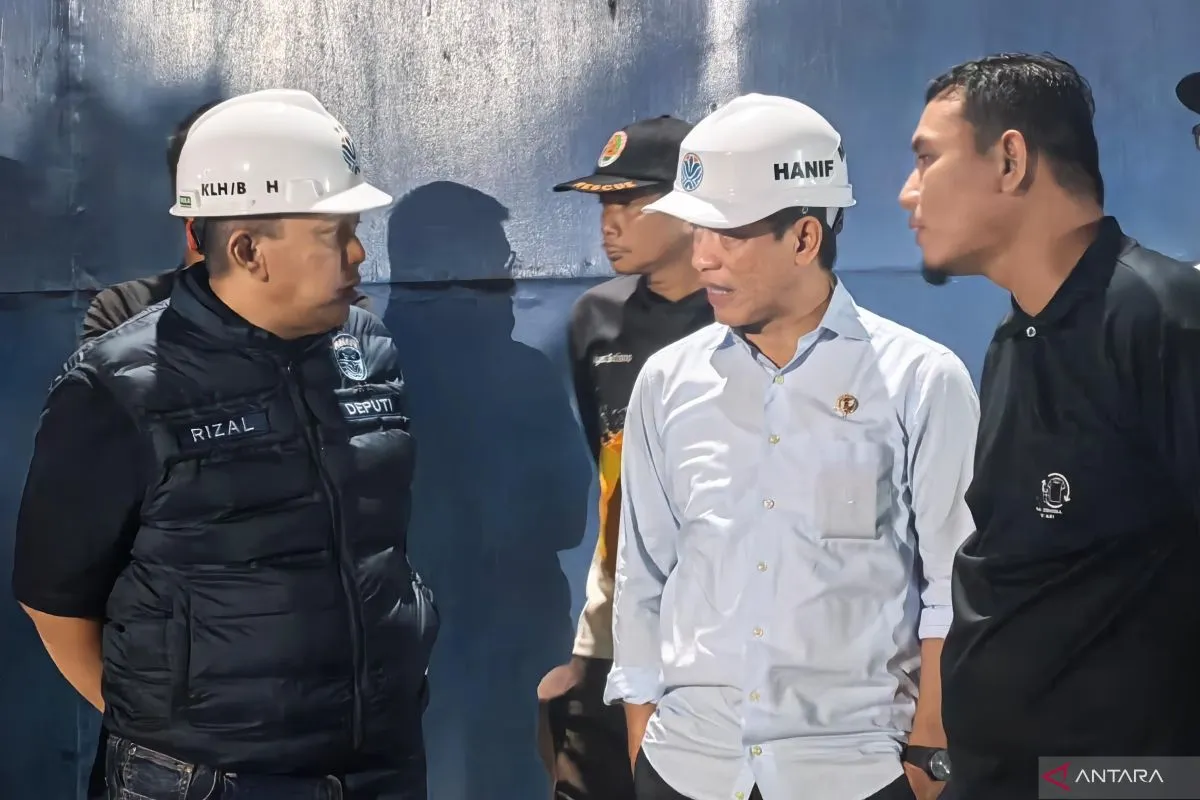
“We must address the root of Jakarta’s waste problem to prevent more victims,” he said after inspecting the landfill on Monday.
A landslide from a 50-meter-high pile of waste in Zone IV of the Bantargebang Landfill on Sunday (March 8) killed four people, providing clear evidence of systemic failures in Jakarta’s waste management that can no longer be tolerated.
The victims were identified as Enda Widayanti, 25, Sumini, 60, Dedi Sutrisno, 22, and Iwan Supriyatin, 40.
Nurofiq said the deadly incident should serve as a serious warning to the Jakarta Provincial Government to immediately end the practice of open dumping, which continues to pose safety risks to residents and workers.
The ministry has launched a thorough investigation and vowed strict law enforcement to ensure that similar incidents do not happen again.
He said the continued use of open dumping at the landfill violates Law No. 18 of 2008, as the current system is no longer capable of reducing safety risks to nearby communities.
“This incident should not have happened if waste management had been carried out in accordance with regulations. The Bantargebang Landfill must become a lesson for all of us to immediately improve practices for the safety of human life and environmental sustainability,” the minister said.
The landfill has long been linked to a series of deadly incidents, including a residential landslide in 2003 and the collapse of Zone 3 in 2006 that left dozens of scavengers buried under waste.
The pattern of systemic failures continued into January 2026 when a landfill foundation collapsed, dragging three garbage trucks into a riverbed. Another collapse of waste piles occurred in March 2026, highlighting the serious risks posed by excessive waste accumulation at the site.
Given the repeated incidents, Nurofiq said those responsible would face firm legal action in accordance with Law No. 32 of 2009 on Environmental Protection and Management.
Violations of the law carry criminal penalties ranging from five to ten years in prison and fines of Rp5 billion to Rp10 billion, or about US$287,000 to US$574,000.
The minister said he had previously warned about the high-risk conditions at the Bantargebang Landfill.
On March 2, 2026, the ministry’s Deputy for Law Enforcement issued a Notice of Commencement of Investigation (SPDP) for several high-risk waste management locations, including the Bantargebang Landfill.
Authorities are prioritizing the evacuation of victims while conducting a comprehensive investigation to hold accountable any negligence in landfill management that endangers public safety.
As a long-term solution, the government plans to convert the Bantargebang Landfill into a facility specifically for inorganic waste by strengthening waste separation at the source and optimizing the Rorotan Refuse Derived Fuel (RDF) facility.
Coordination among government agencies is also being intensified to ensure Jakarta can safely process up to 8,000 tons of waste per day in line with existing regulations.
Related news: Indonesia moves to clear Bantargebang in two years via waste-to-energy
Related news: Nurrofiq seeks solutions to Jakarta's mounting waste problem
Translator: Pradita Kurniawan S, Resinta Sulistiyandari
Editor: Primayanti
Copyright © ANTARA 2026


