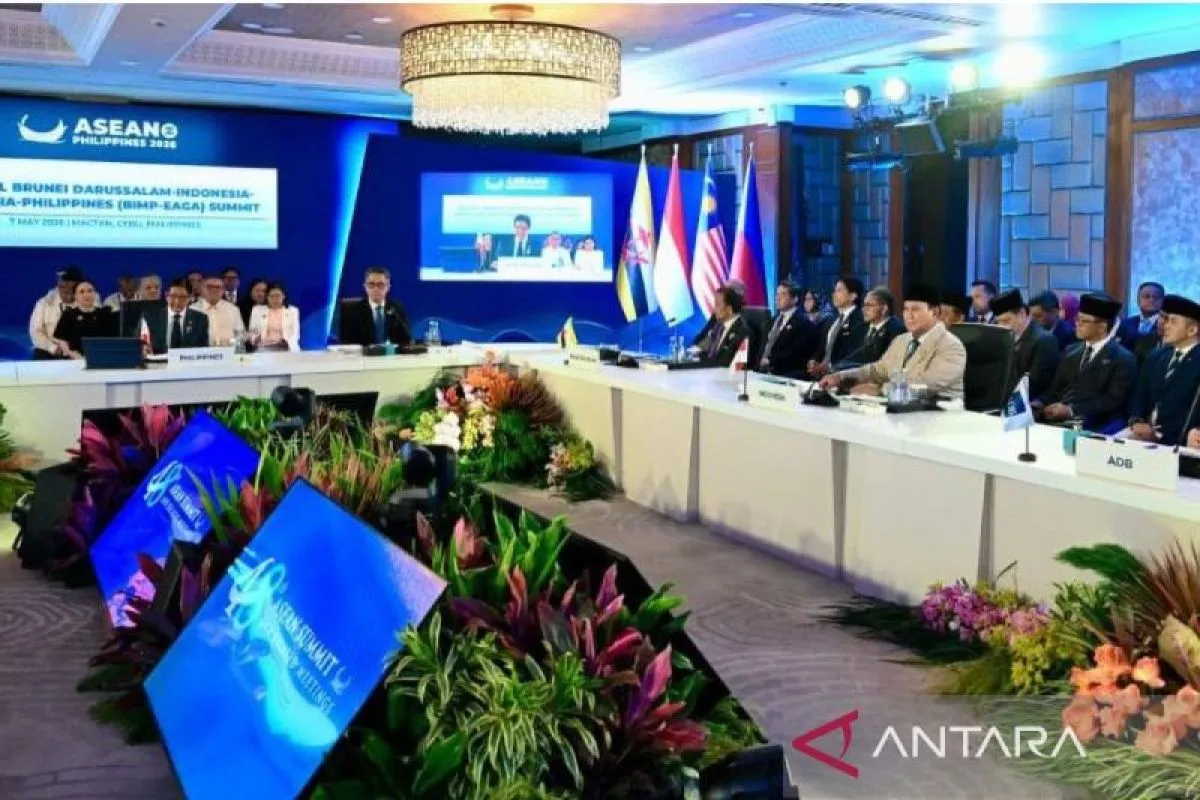
Our energy transition is moving at full speedJakarta (ANTARA) - Indonesia called on Southeast Asian countries to develop clean energy from renewable sources in order to strengthen each regional energy resilience.
Indonesian President Prabowo Subianto, in a statement quoted by ANTARA here on Friday, said the sub-region has enormous renewable energy resources, ranging from hydropower, solar, and wind energy, to fertile land that has not yet been utilized optimally.
"The question is whether we are ready to act on that potential; not only to meet our sub-regional needs, but also to contribute to ASEAN’s energy transition," the President said in his speech at the Special Summit of the BIMP-EAGA in Cebu, Philippines on Friday.
Related news: Prabowo calls for unified ASEAN stance in upholding international law
Prabowo urged ASEAN member countries to take concrete steps in expanding clean energy projects across Southeast Asia, highlighting hydropower development project in Borneo, expansion of solar energy project in Palawan, and wind energy development project in coastal areas.
He also cited several measures currently being undertaken by Indonesia's government to accelerate solar energy development, including the construction of 100 gigawatts (GW) of solar power capacity.
"Our energy transition is moving at full speed. We are building 100 GW of solar power plants. Together, let us improve our energy infrastructure. BIMP-EAGA has enormous potential,” he said.
Related news: President Prabowo urges ASEAN to accelerate energy diversification
Indonesia’s Energy and Mineral Resources Minister Bahlil Lahadalia said after the summit that ASEAN member states had endorsed the BIMP-EAGA Vision 2035 framework, aimed at making Brunei, Indonesia, Malaysia, and Philippines to be more resilient, sustainable, and economically competitive.
The strategic framework, adopted at the 16th Summit in May 2025, focuses on strengthening connectivity, transforming tourism, and promoting economic development.
Under the initiative, the four countries have established sectoral cooperation clusters, including the Power and Energy Infrastructure Cluster (PEIC) which was chaired by Indonesia from 2022 to 2025 before Malaysia takes over for 2026–2029.
Related news: ASEAN must stay resilient amid geopolitical tensions: Minister Santoso
Lahadalia stated projects under the cluster included cross-border electricity interconnections, renewable energy development, rural electrification and energy efficiency programmes.
"These initiatives will strengthen sub-regional collaboration, so that people in remote areas can access affordable energy for better welfare," Lahadalia said.
He added that Indonesia was pursuing a broader energy transition strategy, such as increasing the mix of new and renewable energy; utilizing new energy sources such as hydrogen, nuclear, and ammonia; utilizing electric vehicles (EVs); applying energy efficiency; implementing a moratorium on new coal-fired power plants; and using CCS/CCUS.
"We are also promoting the use of solar power to develop 100 GW of solar power plants in order to reduce fossil fuel consumption. Of course, this requires collaboration from many parties to accomplish the task," he added.
Related news: ASEAN targets digital economy pact DEFA signing by Nov 2026
Translator: Putu Indah, Kuntum Khaira
Editor: Fransiska Ninditya
Copyright © ANTARA 2026


